
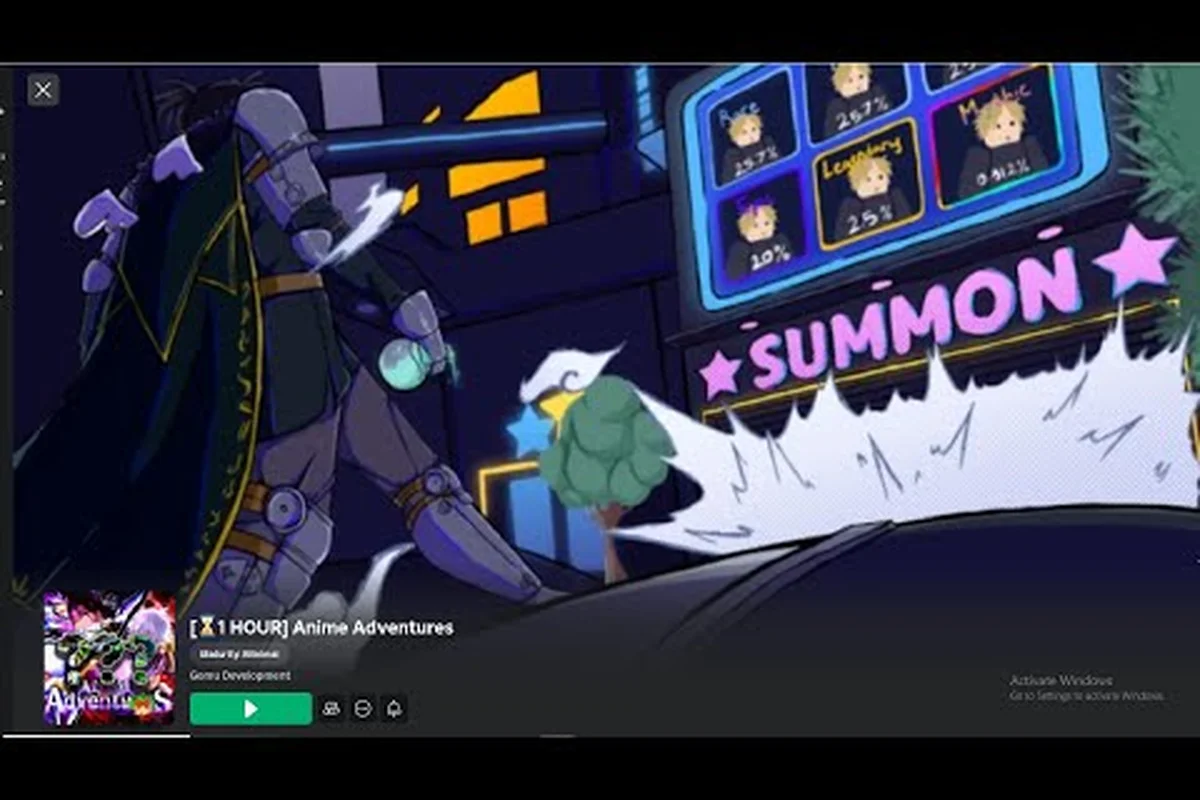
Anime Adventures rewards careful preparation more than blind spending, because a dependable squad is usually stronger than a larger roster built from low-tier units. This anime adventures guide explains how to build your team, position characters for the current wave, and upgrade key heroes without exhausting scarce resources. For example, focus first on a balanced frontline and back line rather than unlocking every unit; trial characters in a simple wave and compare their damage, support effects, and survival before committing rare materials. A strong anime adventures tutorial should also track pull results, run usage, and account progress so each upgrade has a clear purpose.
Understanding the Anime Adventures Core Loop
Anime Adventures is a Roblox strategy and tower-defense game made by Gomu Development. Its central fantasy brings heroes from different worlds together after a catastrophic event, then asks players to defend those worlds against incoming threats. According to the official Anime Adventures game page, players collect unique characters, level them to unlock abilities, and assemble a team for wave-based defense.
That basic loop creates a clear progression path. You summon a roster, choose a dependable damage unit, learn how enemies move, improve the unit that carries your runs, and then widen your account through additional game modes. This summon-to-squad progression matters because collecting more characters alone rarely solves placement or timing problems.
| Progression layer | What it adds | Beginner priority | Source status |
|---|---|---|---|
| Summoning | Adds characters to the account | First | Official |
| Unit leveling | Unlocks unit abilities | Early | Official |
| Squad building | Creates a team for battles | Early | Official |
| Story waves | Introduces tower-defense pressure | Early | Official premise |
| Evolution | Improves a chosen unit | After a stable starter | Community guides |
| Relic and Limit Break | Adds later progression layers | Mid-to-late progression | Community guides |
| Dungeon, Raid, and Infinite Mode | Expands repeatable objectives | After the core loop is comfortable | Community guides |
Start with the battle, not the collection screen
The official game page showed 323,483 visits, 1,832 favorites, and a 30-player server cap during the October 2026 research pass. Those figures demonstrate the game’s visibility, but they do not establish a competitive player threshold or a specific account milestone. For a new player, the best first task is simply to summon enough characters to form a workable team and enter a battle.
For a first clear, treat the team as a test formation rather than a finished squad: use the early stages to compare damage, range, and survival, then keep the unit that contributes most reliably to the clear. The same approach can help with a 30-player server match, where a 323,483-visit, 1,832-favorite game has plenty of visibility but no guaranteed competitive threshold; you still need a dependable core before expanding the roster.
-
Summon characters and note which ones look suitable for your initial squad.
-
Place units where their attacks can cover approaching enemies without competing for the same space.
-
Watch the opening wave instead of repeatedly tapping the interface.
-
Upgrade the unit that contributes most reliably to your clear.
-
Repeat the stage and adjust one placement at a time.
Community videos commonly frame the first session around learning placement and wave timing rather than spending every gem immediately. That advice is especially useful because every early decision should support a clear objective: survive the wave, finish the stage, and learn which unit deserves future investment.
Use verified information and label community systems
The official page confirms Summon, Unit, leveling, abilities, gems, and squad building. Community guides also refer to Evolution, Starfruit, Relic, Limit Break, Gem, Dungeon, Raid, Infinite Mode, and limited-time events. These latter systems are useful for planning, but readers should treat their exact behavior as community-reported unless Gomu Development confirms it in an official update.
The distinction also matters for numerical advice. No reviewed source publishes dependable summon rates, damage values, drop tables, level caps, reward amounts, or a dated release schedule for Update 21. This anime adventures tutorial therefore avoids invented thresholds and focuses on decisions that remain useful when the game changes.
Mastering Unit Placement and Wave Defense
Placement is the first practical skill in this anime adventures walkthrough. Because Anime Adventures uses wave-based tower defense, your units need time to attack, and a weak formation can waste that preparation. The goal is not to fill every available position; it is to create overlapping coverage while keeping enough flexibility to respond to enemy paths.
Read the wave before changing the formation
Start by watching how the first enemies enter and where they gather. Notice whether they move in a straight line, split around structures, or remain clustered near a particular point. You do not need a published enemy guide to make this observation because the battlefield itself provides the information.
| Observation | Likely formation response | Why it helps |
|---|---|---|
| Enemies follow a narrow route | Place key units near that route | Attacks arrive with less travel time |
| Enemies split into two paths | Divide coverage between both paths | Prevents one side from reaching the base |
| Enemies cluster together | Favor an area of sustained coverage | A group can be pressured at once |
| A unit is repeatedly out of position | Move it earlier in the wave | More of its attack can connect |
| Several units cover the same area | Test a different arrangement | Redundant coverage may leave another path exposed |
You must avoid turning these observations into unsupported claims about a particular unit. The reviewed sources verify only two unit names through community mentions: Rukia and Fusion Vegeto. Even those names are not tied to confirmed damage figures, rarity thresholds, or best positions, so use them as known names rather than guaranteed placements.
Separate essential coverage from optional coverage
Think of your squad in layers. Essential coverage should handle the main route or the largest cluster. Secondary coverage can catch enemies that survive the first attack or approach from another direction. Flexible coverage is useful when a stage changes behavior or when you are still learning how your available units interact with one another.
The best formation for a new account is not necessarily the one with the most units. It is the one you can understand. A smaller arrangement makes it easier to see which unit is covering which area, and that clarity helps when you later add stronger characters.
For a broader look at early positioning, the Anime Adventures beginner guide complements this guide with a shorter focus on the opening session. Use it when you need a simple setup checklist, then return here to refine your reasoning after each failed wave.
Upgrade the unit that carries the run
A primary damage role is more valuable than spreading resources across every new character. Choose the unit that contributes most consistently, upgrade it, and observe whether its attacks become more useful. Since the official page confirms that leveling unlocks abilities, progression should focus on reaching that improvement rather than merely watching a level counter rise.
This approach also reduces resource waste. If several units receive small upgrades, none may unlock a useful ability quickly. Concentrating progression creates a clearer feedback loop: stronger coverage, better stage performance, and more confidence in which unit deserves the next summon or upgrade.
Wave-first development also prepares you for later modes. Dungeons, Raids, and Infinite Mode appear in community guides, but learning spacing and timing in the core battles gives you a transferable foundation. A unit that consistently occupies the right role in ordinary waves is easier to evaluate in a more demanding objective than a unit selected only by rarity label.
How to Shape a Squad Around Your Carry
Squad building is a decision process, not a checklist of rare characters. The official game page describes collecting unique characters and leading a team of anime units, while community sources mention a broader progression structure. Because no verified tier list, stat benchmark, or complete roster exists in the reviewed material, the safest approach is to compare function and performance.
Choose one anchor and one flexible support
Your squad can be organized around three jobs, with a fourth slot reserved for a trial unit when it proves worthwhile. Use the anchor for dependable damage on the main clear, the coverage support to hold a second route, and the flexible support to shift into exposed lanes when enemy positioning changes. For example, if a wave’s boss crowds the front line, the flexible unit can handle a safer flank while the anchor remains focused on the boss; if that boss dies too quickly, the same unit can be tested on another route before resources are committed. Upgrade the anchor first, improve coverage support next, and upgrade the flexible support selectively rather than spreading resources evenly across every unit. This approach also avoids treating a Rare or Legendary label as proof of performance, since the unit’s actual contribution in your formation matters more than its rarity.
-
Anchor: The character whose attacks contribute most to the regular clear.
-
Coverage support: The character that protects a second route or helps finish weakened enemies.
-
Flexible support: A unit that can cover a different position when the wave changes.
| Squad role | Selection question | Upgrade priority | Common mistake |
|---|---|---|---|
| Anchor | Does this unit contribute consistently to the clear? | Highest | Upgrading several units equally |
| Coverage support | Does this unit protect a route the anchor misses? | Medium | Placing both units in identical territory |
| Flexible support | Can this unit fill an uncovered area? | Selective | Adding it only because it was newly summoned |
| Trial unit | Does it show enough value to justify further resources? | Low | Treating one strong result as a permanent verdict |
Rarity labels visible on official thumbnails include Rare and Legendary, while community guides also use Mythic, Secret, and Limited. Those labels may help organize the collection, but they do not establish the best unit for a specific stage. Judge the unit by what it does in your own formation and by the strength of the encounters it can handle.
Treat the roster as a testing plan
New characters should enter the squad through a short test. Place the new unit in a real stage, observe its coverage, and compare the result with the formation you already trust. If it performs well, keep it there and consider investing. If it struggles, adjust the placement before deciding that the character lacks value.
This method prevents two common errors: dismissing a unit after one poor setup and overvaluing it because it has a desirable rarity label. It also creates a record of useful information that remains valid even when exact stats change. You will know which character consistently fills a role, which placement works, and which formation clears reliably.
For deeper roster decisions, the Anime Adventures physical DPS team breakdown focuses on team-building decisions, while this guide keeps the emphasis on the full account progression sequence. Use both to separate a unit’s role from the team that surrounds it.
Do not force a fixed upgrade order for every account
There are no verified level thresholds or stat breakpoints, so avoid a rigid plan such as upgrading to a specific level before any other action. The sequence below follows the progression layers supported by official and community sources without pretending that a particular number triggers a specific power spike.
-
Establish one dependable main damage unit.
-
Clear the opening story waves and learn the basic formation.
-
Upgrade the unit that repeatedly contributes to successful runs.
-
Apply the community-reported Evolution layer to that core unit when available.
-
Add Relic and Limit Break progression after the basic squad is stable.
-
Explore Dungeon, Raid, and Infinite Mode through the broader Anime Adventures ability upgrade reference.
Spending Starfruits, Gems, and Limited Resources
Resource management is one of the most important anime adventures tips because early mistakes can leave a collection with no reliable way to progress. The official page mentions gems and says players who miss gems or a limited unit will receive them upon release. It does not publish prices, reward amounts, summon rates, or a complete list of limited rewards, so spending should follow a purpose rather than a guessed formula.
Give every resource a job
Starfruit and gems should support a specific decision before they are spent. If you cannot name the immediate result, wait until the answer becomes clear. This is especially important because a collection-driven game can make it tempting to pull repeatedly without evaluating what the account actually needs.
| Resource type | Best-supported use | Evidence level | Decision rule |
|---|---|---|---|
| Gems | Progress toward a planned unit or account need | Official mention; no rates published | Spend only when the intended target is clear |
| Starfruit | Support the unit that carries your runs | Community guides | Avoid spreading it across a temporary roster |
| Limited-unit opportunity | Save for the release window | Official statement about compensation | Plan around availability, not rumor |
| Battle resources | Retry when learning a formation | Official battle structure | Use to test one change at a time |
Resource purpose before resource quantity is the key rule. A player who knows exactly what a summon is meant to complete is less likely to spend simply because a button is available. This also makes pull decisions easier to evaluate after updates change the available roster.
Separate permanent needs from temporary excitement
A newly released character can feel essential because it is new, but your account’s current need may be damage coverage, a second route, or a reliable way to finish ordinary waves. Compare the new unit with that need before investing.
In practice, treat a new unit as a solution only after checking its role against a current squad requirement. If the squad lacks broad damage coverage, compare the unit’s damage type, attack range, and ability multiplier with the ordinary waves already being cleared. If the bottleneck is single-target pressure, test whether its skill can reach the boss without wasting time on weaker enemies. This prevents a costly pull from replacing one practical gap with another.
-
Need: What problem exists in the current squad?
-
Evidence: What evidence shows the new unit solves that problem?
-
Opportunity cost: What other progress could those resources support instead?
If the answers are vague, the pull is not yet justified. This framework remains useful even when exact values remain unpublished, because it keeps the decision tied to performance instead of excitement. For example, if a unit is being considered for Story Mode coverage, compare its damage type, attack range, and skill multiplier with the wave currently causing stalls; if the unit cannot improve that specific clear, saving the pull for a character that fills the actual gap may be the stronger choice.
Prepare for a limited release without relying on leaks
Community spaces may discuss leaks, rewards, or event timing, but no active code, reward amount, or dated Update 21 release was verified in the reviewed sources. Treat unofficial details as unverified until they appear on the official game page or GomuDev’s official video channel.
The official page states that players who miss gems or a limited unit will be granted those items upon release. That promise gives returning players a reason to pace their resources and check official announcements rather than chase uncertain information. For time-sensitive information, the Anime Adventures current event reference can help separate published announcements from community chatter.
Preparing for Heaven’s Storm and Update 21
The Heaven’s Storm trailer shown on the official YouTube channel received roughly 335,000 views during the October 2026 research pass. The creator’s channel had 121,000 subscribers, three videos, and about 1.5 million total views at that time. These figures show meaningful audience interest, but they do not reveal the update’s release date, unit list, reward structure, or final balance.
Build a checklist instead of a prediction
Community coverage was preparing for Update 21 while the reviewed content cycle centered on Update 20. The sensible response is to prepare for change without claiming details that have not been announced. For example, keep separate notes for confirmed Update 20 balance changes and unverified Update 21 expectations, then check each expected unit, gem reward, or event against the official game page before changing a formation. This avoids treating a fan-made tier list as confirmed Roblox patch information and keeps a “best units” ranking from becoming outdated as soon as new heroes or balance changes arrive.
| Area to monitor | What to verify | Why it matters |
|---|---|---|
| New heroes | Officially shown unit names and roles | Supports a revised squad plan |
| Gems and limited rewards | Official compensation or release details | Prevents rushed spending |
| Balance changes | Notes on the official page or channel | May alter formation priorities |
| Event access | Published availability and requirements | Clarifies when to begin |
| New modes | Official descriptions of objectives | Expands the account roadmap |
Watch the official game page or the official Discord server for announcements, but do not treat chat claims as patch notes. The Discord had 662,720 members with 145,703 online during the research pass, while the Roblox creator group had 83,644 members. Those totals make the community valuable for discussion, yet they still do not convert individual posts into verified game data.
Use the first post-update run as a test
Once Update 21 is officially available, run a familiar stage and compare the result with your previous formation. Watch for changed enemy behavior, altered unit performance, or new rewards. Change one part of the setup at a time so you can identify the effect instead of blaming a vague patch.
The official premise remains centered on saving multiple worlds, so a new update may introduce more characters or scenarios without replacing the basic tower-defense decisions. Placement, upgrade concentration, and clear resource purposes will remain valuable even if specific values move.
A Practical Routine for Continued Account Growth
Consistent progress comes from reviewing what each battle teaches. Keep a small record of the formation, the unit that carried the clear, the stage reached, and the resource change you made. Even if some details are community-reported, a personal performance log is more reliable than an invented tier placement or an unsupported stat threshold.
Use a repeatable session checklist
A useful session can be organized into four short phases, each tied to a measurable outcome so that time spent in Anime Adventures leads to a clearer upgrade decision. Start by checking official announcements for confirmed updates, events, or compensation details, then choose one current unit or feature based on its role in your roster. For example, compare a unit’s damage output with its upgrade cost before committing rare resources; this keeps the battle-to-account feedback loop visible and ensures that every stage attempt informs the next investment rather than simply opening unrelated menus.
-
Review: Check official announcements for confirmed updates, events, or compensation details.
-
Prepare: Decide which current unit or feature deserves attention before opening the relevant menu.
-
Test: Enter a stage, change one meaningful variable, and observe the result.
-
Consolidate: Upgrade the unit that contributed most and avoid spending leftover resources without a plan.
This routine keeps the battle-to-account feedback loop visible. Instead of playing several unrelated modes, every session produces a decision that supports the next session. Over time, the account becomes stronger because you know which investments work, not simply because you opened every available menu.
Know when to stop chasing a reward
Stop pursuing a summon or reward when the expected benefit no longer supports your current goal. That may mean saving gems during a limited window, declining a reroll, or leaving a low-impact unit unupgraded until a stage actually needs it. Community guides mention Reroll, but no reviewed source publishes a universal rule for when it is correct, so evaluate it as a resource choice rather than a routine action.
The same rule applies to events. Check official timing, review the available objectives, and decide what the event rewards could improve before committing scarce resources. The Anime Adventures event walkthrough provides a framework for organizing those decisions without relying on unverified reward values.
Maintain a simple progression checklist
Use this sequence to evaluate your account: start by confirming that your squad can summon and sustain a basic formation, then test its damage in Story Mode waves. Compare each unit’s clear speed, range, and attack uptime rather than judging by rarity alone, and note which role consistently handles the enemy wave. Concentrating upgrades on that proven unit often improves clears more than spreading damage across an unproven roster, because stronger core stats can reduce the number of rotations needed to finish a wave. After establishing a reliable foundation, compare community-reported progression systems and check official announcements for confirmed changes before treating any prediction as settled.
-
Can you summon and maintain a functional squad?
-
Do you know which unit contributes most to your clears?
-
Can you place that unit where its attacks connect reliably?
-
Have you concentrated upgrades instead of spreading them too thin?
-
Can you clear story waves without depending on an uncertain strategy?
-
Have you added community-reported progression systems without skipping the core foundation?
-
Do you review official announcements before reacting to community predictions?
This anime adventures walkthrough avoids promising a mythical unit list because summon availability, Story Mode wave coverage, and account progression can change independently. Instead, treat each pull as an experiment: record a unit’s role, placement, range, and clear time across repeated Story Mode waves, then compare it with your current core. A rare unit that cannot maintain formation pressure may be less valuable than a proven starter unit with reliable attack uptime, so reserve limited upgrade materials for units whose contribution you can measure.
Frequently Asked Questions
What is the best first priority in Anime Adventures?
Your first priority should be a dependable squad that can clear ordinary waves, not maximum collection size. Choose one unit that contributes consistently, place it where its attacks can reach enemies, and learn how the wave moves. The official game page confirms that leveling unlocks abilities, so focused upgrades usually create more value than spreading resources across a temporary roster.
Should new players spend every gem immediately?
No. Give each gem a clear purpose before spending it. The official page mentions gems and guarantees that players who miss them or a limited unit will receive them upon release, but it does not publish prices, rates, or reward amounts. Saving until you know which unit or account need matters most reduces waste and makes later decisions easier.
Which unit should be upgraded first in Anime Adventures?
Upgrade the unit that carries the most regular clears rather than choosing only by a rarity label. Rukia and Fusion Vegeto are the only names verified through community mentions, and their exact stats, positions, and upgrade thresholds are not confirmed. Test available characters in real stages, then focus on the unit that provides the most consistent contribution.
Are Evolution, Starfruit, Relic, and Limit Break confirmed official systems?
The official page confirms characters, unit leveling, abilities, gems, and squad building. Evolution, Starfruit, Relic, and Limit Break appear in community guides, so they should be described as community-reported unless an official update confirms their details. This anime adventures guide uses them to explain progression layers without inventing levels, costs, or stat bonuses.
How should players prepare for Update 21 or Heaven’s Storm?
Check the official game page, creator group, or official YouTube channel for confirmed details, because no dated Update 21 release was verified in the reviewed sources. Keep a flexible squad, avoid spending based on leaks, and test a familiar stage after the update. A structured Anime Adventures tutorial can serve as a reset checklist when balance or rewards change.