
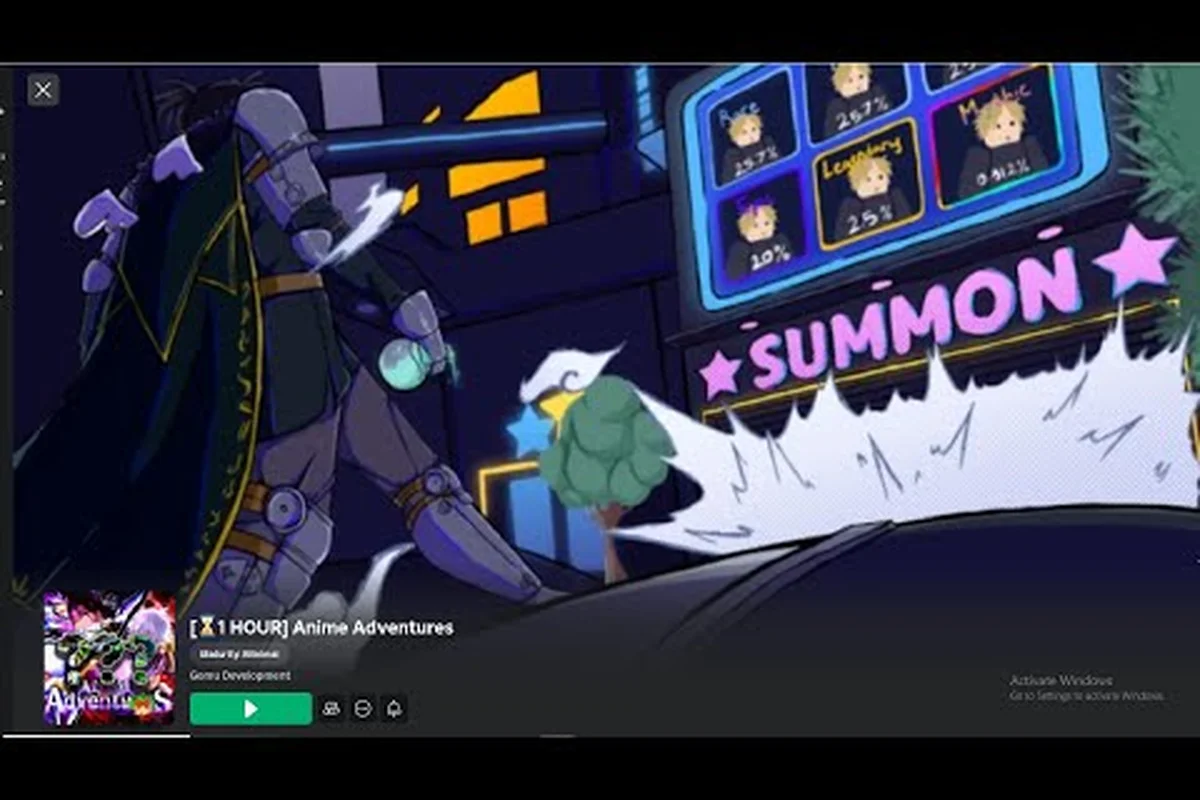
The anime adventures new player guide helps you build a dependable team without wasting early resources. Start by prioritizing character progression, then unlock or improve the Summons that fill key roles before spending materials on a wide roster; a focused team is easier to raise through Adventure stages than a large group split across too many unfinished characters. Protect rare or valuable Summons by checking their role, element, and progression needs, and clear repeatable stages for predictable EXP, gold, and item gains. This early-game foundation also prepares you for the separate goals in an anime adventures returning player guide, where missing progression rewards or previously ignored roster gaps may need to be recovered first.
Anime Adventures New Player Guide: Build a Stable Foundation
Anime Adventures is a Roblox strategy and tower-defense game by Gomu Development, where players collect anime-inspired characters, level them, and position a team against incoming waves. A strong start is less about chasing every new release and more about choosing one dependable damage unit, improving it consistently, and learning how placement affects each encounter.
That matters because early decisions shape how quickly you clear content and how efficiently you use limited resources. The official Anime Adventures game page describes the core loop clearly: collect characters, lead a squad, level units to unlock abilities, and defend multiple worlds from summoned threats.
Your First Objective: Survive and Learn
Your first goal should be consistency, not perfect optimization. In the opening battles, learn when enemies enter, how long each wave lasts, and which lane or map area your chosen unit covers. For example, if your main attacker has a short range, place it where it can hit approaching enemies without exposing your backline; if it targets clustered foes, save it for multi-enemy waves. Recognizing these patterns gives you more value than spending every gem immediately, because each upgrade can then solve a clear need in your team composition.
| First-session objective | What success looks like | Why it matters |
|---|---|---|
| Learn wave timing | You recognize when pressure increases | Better placement decisions |
| Identify your main attacker | One unit consistently handles key waves | Clearer upgrade focus |
| Protect remaining gems | You save until the team has a clear need | More flexible progression |
| Complete opening objectives | You advance through the starting content | Unlocks a broader progression loop |
Wave timing is the first skill to develop because unit selection alone cannot compensate for poor positioning. If a unit cannot reach the relevant lane or lane position during a difficult wave, changing that unit’s level may not solve the real problem.
Pick a Carry Before Adding Support
Community guides generally frame early progress around summoning a roster, choosing one main damage unit, clearing the opening story waves, and evolving the unit that carries most runs. This is a practical principle because a focused upgrade path is easier to understand than spreading attention across an entire roster.
Rukia and Fusion Vegeto are the only unit names that could be verified through reviewed community mentions, but the sources do not confirm detailed stats or a complete ranking. Treat them as examples of community-mentioned units rather than guaranteed starters.
| Roster decision | Benefit | Trade-off |
|---|---|---|
| Focus on one main attacker | Easier to level and test | Fewer immediate options |
| Keep a small support group | More placement flexibility | More upgrade decisions |
| Upgrade every unit evenly | No single unit carries the team | Usually less focused progression |
| Save for desired units | Greater control over roster goals | Takes patience during early sessions |
The Anime Adventures account progression guide expands on how to turn a basic roster into a more organized account, including unit priority and placement decisions that fit this early foundation. For example, after selecting Rukia or Fusion Vegeto as the main damage unit, compare that investment with a smaller support group instead of upgrading every unit evenly; concentrating resources creates a clearer test of Story Mode performance while leaving room for future roster goals.
Anime Adventures Early Game Guide: Summoning and Upgrade Decisions
Your early game begins with a choice between collecting more units and strengthening the units you already have. Neither option is universally correct, but treating gems as a focused budget usually makes early decisions easier to track. Community beginner videos emphasize placement and wave timing rather than immediate spending, which supports starting with a little restraint.
Summon variety can still be valuable because different characters may cover different situations. However, a wide roster does not automatically produce a stronger team. Until you know which unit should lead your attacks, additional summons create more decisions without necessarily improving your results.
When to Summon and When to Save
A practical rule is to summon when the available choice advances a clear roster goal, not simply because a new banner appears. Because no verified summon rates, drop tables, or reward amounts are available, the guide should not promise that any specific pull is efficient or guaranteed.
| Situation | Better decision | Reason |
|---|---|---|
| You lack a dependable attacker | Summon for roster completion | You need a functional core |
| Your main unit performs well | Upgrade the main unit | Consistency improves existing progress |
| You want a specific community-mentioned unit | Save while targeting it | Pull efficiency is unknown |
| You have surplus resources and no clear target | Keep a flexible reserve | Future choices remain possible |
Focused saving gives every future summon a clearer purpose. It also helps you resist treating a new release as an emergency when your existing team still has obvious upgrade paths—for example, improving a dependable Story Mode attacker before chasing a community-mentioned unit. Because banner details, summon rates, and reward amounts remain uncertain, reserve the flexible resources shown in the table for a roster need, a targeted unit, or a later opportunity rather than spending them on a panic pull.
Decide What an Upgrade Is Solving
The official description confirms that leveling units unlocks abilities, but reviewed sources do not publish level caps or stat breakpoints. Instead of chasing an invented number, use this question: does the upgrade solve a specific problem in the current team?
-
If the unit cannot survive long enough to cover a wave, improve its durability through the available upgrade path.
-
If it deals damage too slowly, focus on the option that improves its output or ability availability.
-
If positioning limits its usefulness, test a different map location before relying on another level.
-
If another unit performs the same role more consistently, consider making that unit the main attacker.
Ability access is the clearest official upgrade benefit. A unit that reaches a stronger stage at the right time may become more valuable than a new unit with no established role in your lineup. For example, if a starter unit can unlock an AoE skill before the enemy density increases, upgrading that unit can produce better wave coverage than adding a higher-rarity character who lacks synergy. Because published level caps and ability breakpoints are uncertain, compare the upgraded unit’s actual performance in Story Mode or a repeatable stage rather than assuming the newest recruit is automatically the stronger option.
Keep the First Team Simple
A small initial team makes mistakes easier to diagnose. One main attacker, one complementary unit, and a limited reserve of resources give you enough flexibility to respond to early encounters without maintaining a roster that is too broad to evaluate. The Anime Adventures upgrade guide provides a focused look at wave defense, early upgrades, and practical checks for the first week. Use it alongside the decisions in this guide rather than treating each upgrade as a separate checklist.
Anime Adventures Progression Guide: Move Through Activities in Order
Progression becomes clearer when each activity answers a different question. Story waves teach the combat system, dungeons and raids provide new goals, and community-described systems such as Relics, Limit Breaks, Starfruit, and Infinite Mode add further layers. These later systems are reported by community guides, so their exact requirements should be confirmed in-game.
One main damage unit should remain your progression anchor until it can reliably clear the current Story waves and dungeon stages. If that character still loses tempo while handling the latest wave, jump to a harder activity before improving your setup, since extra difficulty can cost mastery time without strengthening the account. Track Story wave progress, available unit slots, and reward thresholds first; those three checkpoints show whether the next unlock is realistic or merely harder content.
Use a Four-Layer Progression Plan
| Progression layer | Main decision | What to check afterward |
|---|---|---|
| Opening story waves | Learn placement and timing | Can one unit carry key encounters? |
| Unit development | Level the primary attacker | Did its ability access improve? |
| Evolution | Invest in the unit carrying runs | Is the team more consistent? |
| Dungeons and raids | Test the established core | Does a new role need support? |
| Relics, Limit Break, and Infinite Mode | Add progression layers gradually | Are the requirements confirmed in-game? |
Evolution is a community-described system that deserves attention because it can turn a dependable unit into a stronger centerpiece. However, no verified source in the reviewed material provides a universal evolution requirement, so do not plan around a guessed stage or material cost.
Use Dungeons, Raids, and Relics for Different Tests
Dungeons and raids reveal whether your current unit setup can handle different encounter patterns, including repeated waves, staggered enemy spawns, and boss-style damage checks. Relics add another layer of unit development, but their value depends on the unit’s role, stats, and upgrade path rather than on rarity alone. For example, compare the same unit before and after a relic using a repeatable dungeon run: if it improves survival without disrupting stage routes, it may support progression; if it only changes appearance or affects a unit you rarely field, treat it as a collection piece instead of an automatic upgrade.
The Anime Adventures map strategy guide can help you think about stage routes, world progression, and the practical value of changing positions between activities. A unit that performs well in one opening area may not be the right front-line choice elsewhere.
Relic choices should be evaluated against your core plan. If a relic does not improve the unit you expect to carry progression, it may not be worth prioritizing over another part of the upgrade tree. Because drop details are not publicly verified, avoid making claims about exact relic rewards.
Prepare for Mid Game Without Rushing It
The anime adventures mid game guide should focus on a repeatable loop rather than a sudden switch to a new rarity chase. Continue improving the main attacker, test the team in dungeons and raids, and add support when an encounter exposes a missing role.
| Mid-game pressure sign | Likely issue | Practical response |
|---|---|---|
| Main attacker stalls early | Insufficient development | Revisit upgrades and evolution |
| A unit works only in one position | Placement dependency | Test alternate lanes or formations |
| Team survives but deals little damage | Wrong main attacker | Test another core unit |
| New activity is not completing | Missing support or preparation | Review the activity requirements |
Repeatable progress is more valuable than a one-time clear. If your team can complete the same content consistently after a failed attempt, you have a usable foundation. If each success depends on luck, continue improving the core before expanding.
Anime Adventures Returning Player Guide: Reassess Instead of Restarting
Returning to Anime Adventures after time away can feel confusing because new content, units, and community advice may have changed what appears effective. The best response is not to rebuild from zero, but to audit your current team and identify the first system that still needs attention. This is where the anime adventures returning player guide becomes especially useful.
Update awareness matters, but community channels should be treated as a source of leads rather than final authority. The current content cycle is Update 20, while reviewed community coverage is preparing for Update 21. No dated Update 21 release information was verified, so plans should not depend on a rumored schedule.
Run a Four-Part Account Audit
| Audit area | Question to answer | Action based on the result |
|---|---|---|
| Roster | Which unit currently leads the team? | Concentrate upgrades on that role |
| Gem reserve | What is available after planned spending? | Preserve enough for a deliberate choice |
| Team roles | Which enemies disrupt the current formation? | Test a complementary unit |
| Activity access | Which dungeons, raids, or modes are available? | Re-enter them in a controlled order |
The main-attacker test is the center of this audit. Watch several Story Mode waves, then compare each candidate’s normal attack damage, ability range, critical-hit consistency, and active uptime against the current lead. If no unit remains consistently useful, rebuild around the strongest available candidate instead of maintaining several partially upgraded options.
Handle Missing Rewards Carefully
The official page says that players who were missing gems or the limited unit would receive them upon release. If you are still uncertain about a reward, verify its status directly in the official game page or the current in-game interface rather than relying on old code lists or informal claims.
No active code was verified during the research pass, and the reviewed sources did not provide summon rates, level caps, reward amounts, or dated Update 21 details. This is why an official-first check is essential: it separates confirmed information from community reports.
Rebuild Spending Around a Current Goal
A returning player may want several things at once, but every account needs a priority. Decide whether the immediate goal is completing difficult waves, improving the core unit, or preparing for a specific activity. Then assign gems and upgrade materials to that goal.
The returning-player reset is not about discarding the account; it means removing low-confidence spending priorities before committing gems or upgrade materials. A practical approach is to list the current goal, the units or roles that support it, and the next required resource. For example, if the goal is difficult-wave progression, compare the main damage dealer’s current stats with the recommended wave power, then invest only in upgrades that close that gap. This keeps progression focused and prevents scattered pulls or upgrades from weakening the account’s primary combat plan.
-
Stop upgrading a unit that no longer fits the team’s main role.
-
Avoid a wide summons plan when only one role is missing.
-
Recheck evolution and Limit Break requirements before committing resources.
-
Confirm the activity and its current requirements in the interface.
Community reports can still help identify what players are testing, especially around Update 21, but they should not replace the game’s own displayed information. This protects the account from acting on a stale guide or an unverified reward claim.
Practical Anime Adventures Decisions for Every Player
The anime adventures new player guide is ultimately a decision framework: improve the unit that carries your runs, use summons to fill a known gap, and verify uncertain information in the game. That approach works for a first session, a return after a long break, and the middle stretch when more systems begin to overlap.
A Simple Weekly Routine
A short weekly routine prevents resources from drifting into low-impact upgrades without requiring exact farming figures that have not been published. For example, if Story Mode clears feel stable but Boss fights remain inconsistent, reserve enough gems for a measured improvement to the main attacker rather than spreading every resource across the roster. Since exact gem and ticket income can vary with current banners, events, and reward changes, compare progression through several waves and prioritize upgrades that produce a visible gain in the unit already carrying your damage.
| Routine stage | Action | Outcome |
|---|---|---|
| Review | Check current units, gems, and activities | Identify the most important gap |
| Test | Run several waves with the current team | Measure the main attacker’s consistency |
| Upgrade | Improve the unit carrying progression | Strengthen the established core |
| Expand | Add one support or test one new activity | Reduce dependence on a single unit |
| Verify | Confirm reward and update details officially | Avoid acting on unverified claims |
One-change testing helps you understand what actually improved performance. Change one part of the team at a time, such as the main attacker or a position, so you can see whether the result came from the upgrade or from the map.
Spend, Save, or Test
| Current result | Resource decision | Reason |
|---|---|---|
| Core team struggles in basic content | Upgrade the main unit | Basic reliability should come first |
| Core team is stable but lacks coverage | Summon for a missing role | Variety now has a purpose |
| Core team performs well and reserve is large | Save for a clear target | Unknown rates make patience valuable |
| New mode has different demands | Test before committing broadly | The mode may reward a different formation |
A clear objective should determine every material purchase, whether the goal is Story Mode progression, clearing a group raid, or preparing for a limited-time event. For example, if a new player is blocked by a boss that outpaces the current main unit, prioritize that unit’s damage or survivability instead of collecting another random summon; if the team already clears Story Mode reliably, save for the exact character needed for the next event. Without a defined target, even a generous resource supply becomes scattered across a roster that never reaches full potential.
Avoid Common Beginner Mistakes
-
Chasing every new unit: A larger roster is not automatically stronger than a smaller, functional team.
-
Trusting a fixed tier list: No verified official ranking or complete stat table was available in the reviewed sources.
-
Assuming exact milestones: Level caps, stat breakpoints, drop rates, and reward amounts were not published in the reviewed material.
-
Spreading upgrades evenly: One unit that can carry progression usually offers a clearer return than many units that each fall short.
-
Ignoring positioning: Better levels cannot fix a unit that is placed where it cannot cover the important part of a wave.
-
Buying for a rumored update: Current content can be improved without waiting for a future release whose date remains unconfirmed.
Frequently Asked Questions
What should a new player focus on first in Anime Adventures?
A new player should focus on learning wave timing, choosing one dependable main damage unit, and improving that unit before spreading resources across the roster. Community beginner videos also emphasize placement and wave timing over spending every gem immediately. The goal is to create a core that clears opening content consistently, not to collect every available character at once.
How should returning players rebuild their team?
Returning players should audit their current account before rebuilding from scratch. Identify the unit that most consistently contributes damage, check whether its development is complete, and compare that result with other roster members. Then fill a clearly missing role through summoning or placement changes instead of making disconnected purchases.
Which progression systems should come first after the opening waves?
After learning placement and wave timing, prioritize the unit that carries most runs, then consider its evolution. Dungeons, raids, Relics, Limit Break, and Infinite Mode come from community guides and should be checked against the current in-game requirements. These systems should expand a stable foundation rather than compensate for a team that cannot clear the opening content.
Are there verified summon rates or level caps for Anime Adventures?
No verified summon rates, level caps, stat breakpoints, drop tables, or reward amounts were available in the reviewed sources. A responsible guide should not invent exact numbers. Make decisions by checking the in-game interface and the official game page, and treat community reports as provisional information unless Gomu Development confirms them.
Is it worth saving gems for a limited unit?
Saving can be sensible when a specific target is clear, but the benefit depends on your current roster and how well the existing team performs. The official page states that players missing gems or the limited unit would receive it upon release. Until that status is confirmed in the current interface, avoid spending your entire reserve on a distant goal.