
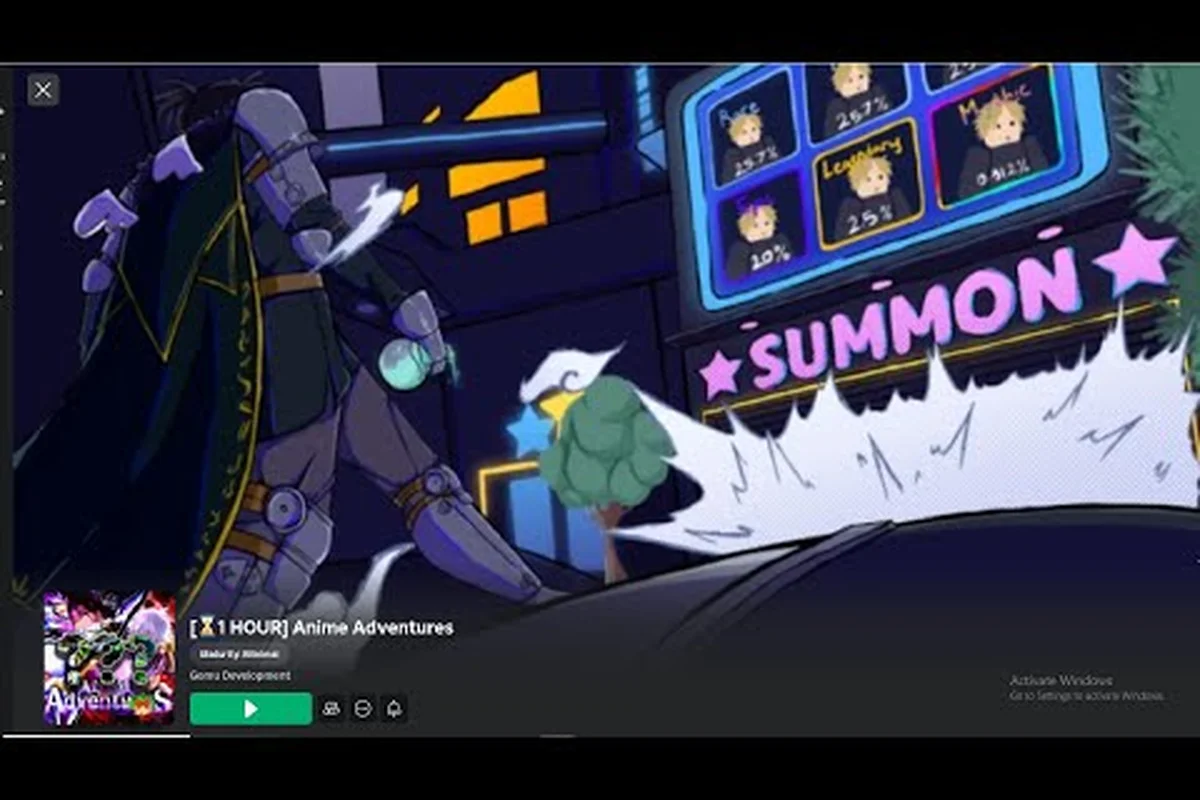
Anime Adventures secret units matter because a rare pull can reshape your squad’s role coverage, not merely improve its collection value. A useful ranking must separate confirmed unit rarity from unverified rarity claims, compare each unit’s role, ability scaling, upgrade requirements, and summon availability, and flag whether evidence comes from the game, developer posts, or community testing. For example, a unit with strong tower-defense utility may deserve a higher practical rating than a rarer unit whose role overlaps an existing team member, so scarcity alone is not enough to justify a top placement.
The official Anime Adventures game page confirms the core loop: collect anime-inspired characters, lead a team, level units to unlock abilities, and defend against tower-defense waves. However, Gomu Development has not published a complete tier chart, summon rates, damage values, or a complete secret-unit list. The guide below therefore uses a transparent evaluation framework, explains where community information ends, and helps you judge every rare unit without relying on unsupported rankings.
Secret Unit Evaluation Criteria
Secret, Mythic, and Limited labels can sound like official grades, but the reviewed official material only visibly identifies Rare and Legendary rarity on thumbnails. Community guides also use Mythic, Secret, and Limited, so those terms should be treated as community-reported categories until confirmed in an official announcement.
That distinction matters because evaluating the Anime Adventures best secret units requires separating confirmed mechanics from player interpretation. A unit can be exciting because of its label, yet still be weak for a particular mode, expensive to obtain, or difficult to use correctly.
Rarity versus practical value
Rarity describes acquisition, not performance. A highly restricted unit may be worth building around, but rarity alone cannot prove that it outperforms a dependable beginner choice. The more useful question is whether its ability improves your team after accounting for upgrade cost and the situations where you will actually use it.
| Evaluation factor | What to check | Strong investment signal | Warning sign |
|---|---|---|---|
| Rarity | How the unit is classified | It matches a label you specifically want | The label is only a community guess |
| Role | What the unit contributes | It strengthens a clear squad need | It duplicates another team slot |
| Upgrade value | Whether evolution rewards investment | Its progression path supports your plan | Upgrades consume too many resources |
| Mode fit | Where it performs | It helps in relevant stages or modes | It only looks good in one situation |
| Acquisition | How it enters your collection | The method is clear and repeatable | Drop or reward information is uncertain |
The official rarity labels should carry more weight than unsourced tier labels. Still, even an officially identified Legendary unit needs a role-based review because the game supports several kinds of unit progression, including leveling and evolution as described by community guides.
The four-question secret-unit test
Use these four questions whenever a new Secret or Mythic unit is announced or added to your collection: first, check whether its Ability fills a specific DPS, AoE, range, or support gap; then compare its Zenith requirement and upgrade cost with the units already occupying those roles; next, test whether it remains effective in late-game waves; and finally, verify its rarity, availability, and Ability through official announcements before committing resources.
-
Does it cover an existing weakness? A unit that fixes a clear damage, coverage, or support gap is usually more valuable than another generalist.
-
Can you afford to develop it? Compare the unit’s expected resource demand with the rest of your account rather than judging it in isolation.
-
Does its effect remain relevant? Strong early performance matters, but a durable unit should still contribute as the game becomes more demanding.
-
Can you verify the information? Confirm the unit’s name, rarity, availability, and ability details through official sources when possible.
This method also protects the Anime Adventures best limited units evaluation from becoming a popularity contest. Limited availability may increase urgency, but it does not establish a unit’s long-term role or prove that it is the correct pick for every account.
Best Secret Units by Role and Value
A responsible tier list can judge categories and decision criteria without inventing a named S, A, B, or C roster. The available evidence verifies only two unit names from community mentions: Rukia and Fusion Vegeto. Because the full roster and official placements are unavailable, neither should be given a permanent tier based on community emotion alone.
Role-based comparison
The strongest approach to the Anime Adventures best secret units is to compare what each unit does for your roster. Official materials confirm that units are leveled to unlock abilities and placed into a team, making fit more meaningful than a simple rarity ranking.
| Unit category | Best reason to pursue | Ideal roster need | Main acquisition concern |
|---|---|---|---|
| Secret | A scarce unit that fills a specific combat role | A proven gap in your current squad | Availability may be unclear |
| Mythic | A high-rarity unit with meaningful team utility | A long-term centerpiece | Community-reported rarity may lack patch-note confirmation |
| Limited | A time-sensitive unit connected to a release or event | Immediate use during its availability | The official page notes a limited unit may be granted at release, but provides no complete schedule |
| Legendary | A high-rarity unit shown on official thumbnails | A verified role after checking its details | Legendary does not automatically mean best for every mode |
| Rare | A more accessible option for completing a squad | Early coverage without premium investment | It may need more development to match rarer units |
This table is a decision framework, not an official placement chart. Community lists can change before every update, and the current content cycle reviewed for this article was Update 20, with community coverage preparing for Update 21. Treat any named ranking as temporary unless Gomu Development confirms it.
Assessing Rukia and Fusion Vegeto
Community mentions identify Rukia and Fusion Vegeto, but the reviewed sources do not provide verified ability descriptions, damage figures, summon rates, level caps, or official tiers. Their names can therefore be included in discussion, but claims about their exact strength would go beyond the available evidence.
| Verifiable point | Rukia | Fusion Vegeto | Practical takeaway |
|---|---|---|---|
| Community-mentioned name | Yes | Yes | Both are relevant names for further research |
| Official tier placement | Not published | Not published | Do not assign a permanent S or A grade |
| Verified damage value | Not published | Not published | Compare real performance in the player’s own stages |
| Verified acquisition method | Not published | Not published | Confirm the source before planning scarce resources |
| Verified mode advantage | Not published | Not published | Use trial results and team need as the deciding factors |
For these named units, record the mode, stage, team, upgrade level, and visible outcome during testing. Because the official page supports a 30-player server cap, testing with others can help compare approaches, although server size does not establish a unit’s tier. The Anime Adventures unit meta guide offers a useful place to organize the broader comparison without pretending that community placements are official.
Starter, Free, and Early Game Unit Choices
Early progress is about building a dependable foundation, not chasing the most restrictive label. Official information confirms that players collect characters, level units to unlock abilities, and build squads. That makes upgrade access and role coverage more useful selection criteria for the Anime Adventures best starter units.
The early-game priority order
Start with a squad that can clear available content, then improve it with rare or restricted pulls. A secret unit is not a beginner solution if you cannot level it consistently or if its key ability is unclear. A limited unit also may not be available outside its release window, so the foundation must stand on its own.
| Development stage | First priority | Secondary priority | Unit choice to delay |
|---|---|---|---|
| New account | Clear early waves and learn controls | Fill basic squad roles | Premium pulls with uncertain value |
| Early game | Add a unit that solves a visible weakness | Prepare limited resources for high-rarity units | Duplicate generalists |
| Mid game | Test rare units in multiple modes | Develop one favorite team around strong synergy | Chasing every new release |
| Late game | Expand coverage across demanding content | Balance progression, rarity, and availability | Units that need online-only access or unclear information |
This sequence supports the Anime Adventures best free game units search naturally: free acquisition should be evaluated by what the unit does, not by whether it is labeled free in an unofficial list. A freely obtained generalist can remain valuable early, while a premium unit may take longer to surpass it once properly developed.
Why a free unit can be the better early pick
A unit available without a premium purchase reduces the cost of learning the defense loop. If it contributes a role your squad lacks, it can produce immediate progress even when another unit has a more prestigious rarity label. The best early team is therefore the one that lets you test additional strategies without spending every resource on one uncertain pull.
Community guides mention Summon, Evolution, Starfruit, Relic, Limit Break, and Gem systems. Because these details come from community coverage rather than official patch notes, treat their exact use as version-sensitive. The practical recommendation remains simple: level the units you already have, understand their abilities, and reserve scarce materials for a unit whose role you can evaluate. Players building around low-cost acquisition can also use the Anime Adventures best dungeon team guide to compare role coverage. The key is to evaluate team function instead of assuming that the rarest available unit belongs in every lineup.
Mythic and Limited Unit Pull Strategy
Mythic and limited units can change collection priorities, but neither category has a published summon rate, drop table, reward amount, or dated release schedule in the reviewed sources. The official page only mentions gems and says a limited unit may be given to players upon release. A careful strategy must therefore separate known availability signals from unverified community expectations.
Mythic acquisition checklist
The Anime Adventures best mythic units discussion is often filled with confident tier claims that the developer has not published, so a unit’s rarity alone should not be treated as proof of combat value. Before planning a pull, verify the unit’s official identity, inspect its ability description, and compare its practical use with the roles already covered by your roster; a Mythic unit that duplicates a stronger owned unit may offer less benefit than its label suggests.
-
Confirm that the unit exists in the correct game: place ID 117965110267191, universe 6930929888.
-
Check the official game page or an official video channel for a name, rarity label, ability description, and release information.
-
Treat community lists as temporary evaluations because they can change before updates.
-
Avoid videos, guides, or images from similarly named Roblox games; the official page explicitly warns that other games using the Anime Adventures name are not affiliated with Gomu Development.
-
Decide in advance whether the unit improves a specific role, rather than pulling solely because its label sounds prestigious.
| Mythic decision checkpoint | Pull if the unit… | Wait if the unit… |
|---|---|---|
| Role clarity | Fills a documented team need | Only has an impressive label |
| Upgrade plan | Fits your available gems and materials | Requires an unclear investment level |
| Mode value | Helps in stages you regularly clear | Has no relevant use case |
| Information quality | Has official or clearly attributed details | Relies entirely on unsourced tier rankings |
| Collection goal | Completes a priority for your account | Duplicates a stronger owned role |
For Anime Adventures best limited units, add one more filter: check whether the unit is relevant to the current event or release window. The Anime Adventures event guide can help organize the timing side of that decision, although exact event windows and release dates should still be confirmed through official announcements.
Limited units and budget discipline
A limited unit creates a false sense that every available gem must be spent immediately. Before acting, write down the squad problem it is supposed to solve, the stages where you will use it, and the upgrades it needs. If the answer is merely “it is limited,” keep your resources until official details reveal a clear benefit.
This approach also reduces the risk of confusing release rewards with permanent summon rates. A unit provided upon release does not establish that duplicates are common, that rerolls are unlimited, or that a particular banner has a favorable odds ratio. No active code was verified in the reviewed material, so code-based acquisition plans should not be treated as reliable.
Late Game Secret Unit Investment Checklist
Late-game value depends on progression efficiency, not just high rarity. Community guides mention Limit Break, Relic, Starfruit, and Gem systems, but the reviewed sources provide no level caps, costs, or damage bonuses. That makes a late-game recommendation inherently conditional: compare what you can verify with what the community believes.
Verify before committing scarce resources
Before investing heavily in the Anime Adventures best late game units, confirm the unit’s official identity, its role, and whether the information applies to the current update. A screenshot can help track performance, but it should not become proof of a universal tier unless the same results repeat across comparable teams and stages.
| Verification item | Reliable source | Community source | Avoid relying on |
|---|---|---|---|
| Unit name and rarity | Official game page or official video | Player reports | Unattributed tier images |
| Ability description | Official announcement or game interface | Guide explanations | Invented damage numbers |
| Availability | Official release information | Community discussion | Unverified banner odds |
| Upgrade effects | In-game tooltips or official notes | Player testing | Assumed level-cap bonuses |
| Mode performance | Repeated in-game comparison | Shared teams | One isolated clear |
Late-game players should watch for two separate upgrades: raw strength and resource efficiency. A unit that performs well but needs far more investment may be less valuable than a slightly less prestigious unit that fits an existing team and reaches useful performance quickly. Neither the official page nor community reviews provide enough numerical detail to calculate a universal return on investment.
Recheck after every content update
The reviewed content cycle was Update 20, while community coverage was preparing for Update 21. Because rankings can shift before updates, keep a short decision log for each rare unit: current squad role, verified source, last clear tested, and unresolved questions. This habit makes it easy to distinguish a genuine improvement from a temporary community reaction.
The broader Anime Adventures Mythic Units overview is a natural companion reference because it can help organize ownership and release-related questions. The meta guide mentioned earlier can then track the resulting team impact. Together, those references create a process for evaluating updates without claiming that any placement is permanent.
Community Information and Source Limits
Player experience is useful for discovering strategies, but it is not interchangeable with official data. The reviewed community guides helped identify progression systems and mode names, while the official game page supplied the premise, core gameplay description, public counters, and warnings about unaffiliated games.
What can be said with confidence
The official Anime Adventures page identifies the game as a strategy and tower-defense experience created by Gomu Development. It says players collect characters, lead anime units, defend against waves, level units to unlock abilities, and build a squad. Public counters during the October 2026 research pass showed 323,483 visits, 1,832 favorites, and a 30-player server cap. The page also notes that the game page was created on December 17, 2024, and showed an update on October 4, 2026. These figures describe the page at that time rather than the number of active players or the size of every server.
What remains unverified
| Topic | Available information | Responsible presentation |
|---|---|---|
| Full secret-unit roster | Only Rukia and Fusion Vegeto have verifiable community mentions | Do not publish a named top-ten list |
| Tier placements | Community lists exist, but no official tier chart was found | Present a decision framework |
| Summon and drop rates | No official rates were published in reviewed sources | Do not estimate percentages |
| Damage and level caps | No verified values were provided | Advise in-game testing |
| Update 21 schedule | No dated release was verified | Do not promise a launch date |
| Codes | No active code was verified | Do not publish a code list |
| Community systems | Evolution, Starfruit, Relic, Limit Break, and related terms appear in guides | Label them community-reported |
The official Discord linked from the game page provides a large community hub, and community guides use it for announcements, event discussion, and team help. During the research pass, the server showed 662,720 members with 145,703 online, while the Roblox creator group listed 83,644 members. These are platform counters, not official patch notes, so release dates, drop rates, and tier claims shared there should be checked against the game page or official video channel.
This source discipline is essential when discussing Anime Adventures best secret units because community guides can document Evolution, Starfruit, Relic, and Limit Break systems without establishing an official secret-unit tier chart. For example, a guide may report that Rukia or Fusion Vegeto is useful in a particular team, but that experience should remain a community-reported recommendation rather than proof of a confirmed roster position, fixed drop rate, or verified secret-unit ranking. This distinction keeps practical unit advice useful while preventing unsupported claims about the best mythic units, limited units, free units, early-game units, and late-game units.
Final Secret Unit Ranking Checklist
The best secret unit for your account is the one that fills a needed role, fits your resources, and has trustworthy information. That conclusion may be more accurate than a broad named tier list, especially because the official game has not published complete tier placements, numerical performance data, or detailed availability rules.
| Decision stage | Question to answer | Evidence to record |
|---|---|---|
| Discovery | Is this the correct Anime Adventures game? | Place ID, unit name, visible rarity |
| Evaluation | What role does the unit improve? | Damage, utility, or coverage need |
| Testing | Does the result hold in a relevant mode? | Stage, team, upgrade level, outcome |
| Investment | Can the unit progress without starving the squad? | Required gems, materials, and other upgrades |
| Confirmation | Is the information official or community-reported? | Source, update, and date checked |
| Long-term plan | Will the unit remain relevant after the next update? | Strengths, weaknesses, and replacement path |
A limited acquisition window can justify acting sooner, while a permanent secret unit can justify a more measured investment plan. A Mythic or Legendary label may improve collection appeal, but it still needs to survive a role-based test. The same standard applies whether you are searching for Anime Adventures best secret units, Anime Adventures best mythic units, Anime Adventures best limited units, Anime Adventures best starter units, Anime Adventures best free units, Anime Adventures best early game units, or Anime Adventures best late game units.
In short, the most useful tier list is a repeatable process rather than a permanent S-to-C chart. Confirm the unit, test its role, watch the resource cost, and revisit the decision after updates. That approach produces a collection and squad built on evidence instead of unsupported tier lore.
Frequently Asked Questions
What are the Anime Adventures best secret units right now?
There is no official full ranking of Anime Adventures best secret units, and the reviewed sources do not confirm a complete roster, tier placements, damage values, or summon rates. Use a role-based framework instead: choose a verified unit that improves a clear team need, fits your upgrade resources, and performs well in the modes you play. Rukia and Fusion Vegeto are the only unit names with verifiable community mentions in the reviewed material.
Are Anime Adventures best mythic units always stronger than Legendary units?
No. Rarity does not automatically determine performance in every mode, and the official page only visibly identifies Rare and Legendary on thumbnails. Mythic is also used in community guides, so confirm a unit’s classification before making a strong claim. Compare its actual role, upgrade requirements, and results against your current squad rather than assuming the highest label always provides the best value.
How should I choose Anime Adventures best limited units before a release ends?
Start with the problem the limited unit is expected to solve, then confirm its ability and release details through official channels. The official page mentions a limited unit may be given to players upon release, but the reviewed sources do not publish a complete schedule, reward amounts, or banner rates. Avoid committing every available gem without a clear team need, and treat community drop-rate claims as unverified until officially confirmed.
Can free units work well for Anime Adventures best early game units choices?
Yes. A free unit can provide better early value when it covers a missing role, is easy to level, and helps you clear content that unlocks later options. Official materials confirm that leveling units unlocks abilities and that players build squads, so functional progression matters more than prestige. Build a dependable foundation first, then decide whether a rare or restricted pull offers a measurable improvement.
What information is required to rank Anime Adventures best late game units?
You need the unit’s verified identity, role, upgrade path, acquisition method, and performance in relevant stages. No reviewed official source supplies universal damage values, level caps, or tier placements, so late-game rankings should include test conditions and the update date. Recheck your decision after content changes because community lists often shift before updates, and a strong unit in one mode may not be the best investment for every account.