
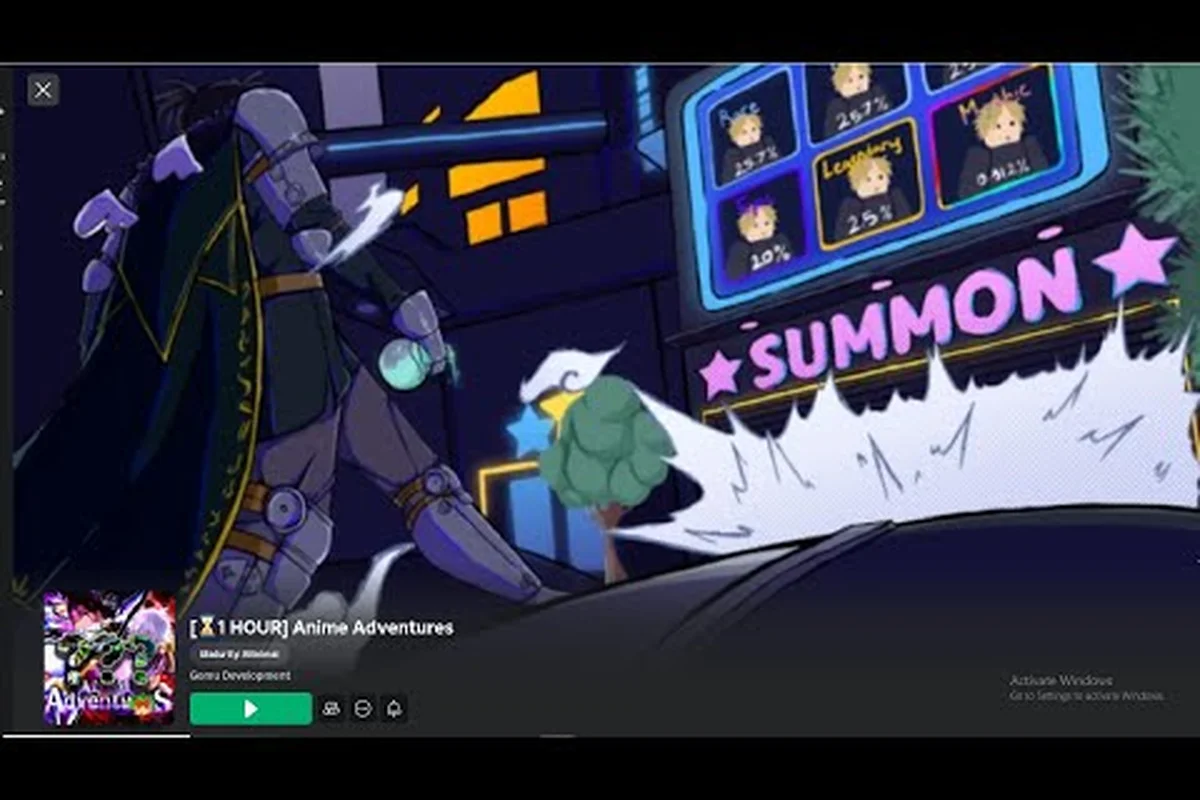
Anime Adventures mythic units remain difficult to evaluate because official odds, complete stat sheets, and pity rules are unpublished. Instead of treating estimated percentages as confirmed rates, compare known unit details—such as a mythic unit’s element, passive skill, and role—against the roster in your own inventory. For example, a secret unit offering strong support may be more valuable for finishing a restricted stage than a limited unit with higher reported rarity. Community pull logs can reveal practical drop frequency, but they should be labeled as unverified observations, while the unit release schedule and summon history should be checked before spending Robux.
Understanding Anime Adventures Mythic Units and Verified Rarity
The official game page identifies Anime Adventures as a Roblox strategy and tower-defense game developed by Gomu Development. Its premise brings heroes together after threats arrive from multiple worlds, while the core loop has players summon characters, build a squad, level units, and defend against waves. That foundation makes unit collection and squad planning central to progression.
However, the meaning of “mythic” needs careful treatment. Rare and Legendary appear as rarity labels on official thumbnails, while Mythic, Secret, and Limited are community labels used in player guides. This distinction matters because community categories should not be presented as formally documented rarity tiers until the developer confirms them.
| Label | Where it appears | What can be confirmed | What remains unverified |
|---|---|---|---|
| Rare | Official thumbnails | The label is visible | Exact acquisition rules |
| Legendary | Official thumbnails | The label is visible | Exact acquisition rules |
| Mythic | Community guides | Players use the category | Official definition, banner odds, pity rules |
| Secret | Community guides | Players use the category | Official definition, release rules, availability |
| Limited | Community guides and official page | A limited unit may be offered on release | Exact schedule, requirements, reappearance rules |
The table also reveals an important boundary: a label can be widely discussed without having an official rules page. That is especially relevant when evaluating Anime Adventures mythic units, because players may incorrectly treat a community rarity system as a fixed ladder with known percentages.
Community-Reported Unit Mentions
Only two unit names have verifiable community mentions in the reviewed material: Rukia and Fusion Vegeto. Even their exact rarity, role, banner, and performance cannot be confirmed from the available official material, so a responsible guide should not attach invented stats or rankings to them.
The broader Anime Adventures Unit Index can help organize confirmed and community-reported entries, but users should treat any name not supported by current official game information as provisional. A unit appearing in a guide, thumbnail, message, or community discussion does not automatically establish its current banner availability.
| Evidence level | Example claim | Recommended treatment |
|---|---|---|
| Official game page | Players collect characters and build squads | Present as confirmed gameplay |
| Official thumbnail | Rare and Legendary labels | Present as visible rarity labels |
| Community guide | Mythic, Secret, or Limited classification | Label as community terminology |
| Community mention | Rukia or Fusion Vegeto | Name it, but avoid unsupported stats |
| Unsourced claim | Exact pull percentage or pity counter | Treat as unverified |
This evidence ladder prevents a community label from becoming a false official promise. It also keeps the Anime Adventures summoning guide practical: a player can still evaluate a unit by role, availability, progression needs, and team fit even when the game has not published a complete stat sheet.
Why Rarity Is Not the Same as Value
Rarity usually signals excitement, but it does not automatically answer the practical question of whether a unit improves a squad. The official page says units are leveled to unlock abilities, which means collection alone is only the beginning. A valuable unit needs a role that complements the existing lineup and progression path that remains useful after the initial pull.
Collection value comes from a unit’s perceived rarity, theme, and scarcity. Combat value depends on its abilities, attack pattern, range, and compatibility with other units. Account value depends on how much of the unit’s development is documented and how confidently players can plan around it. Keeping these ideas separate prevents a rare reveal from being treated as an automatic upgrade.
Mythic Unit Value Without Published Stats
A reliable evaluation of Anime Adventures mythic units must combine confirmed mechanics with player judgment instead of fabricated DPS charts. The official page confirms that leveling unlocks abilities, yet it does not publish damage values, level caps, unit skill descriptions, or comparative rankings. Any guide that fills those blanks with precise numbers should be treated cautiously.
Start with role coverage and ability access. Players should ask what a unit contributes that their current squad lacks, whether those benefits become available through leveling, and whether the unit can fill a position the player expects to repeat. These questions remain useful even when the exact numbers are unknown.
| Evaluation factor | Strong reason to value a unit | Caution signal |
|---|---|---|
| Role coverage | Fills a clear squad need | Overlaps with an existing unit |
| Ability access | Its contribution appears through leveling | Key benefits remain unconfirmed |
| Gameplay fit | Supports the current defense approach | Relies on an unverified stage strategy |
| Rarity | Matches the banner or collection goal | Hype is the only supporting reason |
| Availability | Availability is clearly stated | Community guesses are treated as facts |
| Progression cost | Expected development path is clear | Upgrade costs or materials are invented |
This framework also helps with Anime Adventures secret units and Anime Adventures limited units. Scarcity may increase interest, but a unit is more useful when its role, availability, and development path can be understood. A clear unknown is safer than a precise claim that cannot be verified.
Separating Confirmed Mechanics From Community Interpretation
The official game page provides the reliable foundation: characters are collected, squads are built, units are leveled to unlock abilities, and defense occurs in tower-defense waves. It also mentions gems and a limited unit that players receive upon release. Community guides add terms such as Summon, Evolution, Starfruit, Relic, Limit Break, Reroll, Dungeon, Raid, and Infinite Mode.
Those community terms can describe the player experience, but they should not be converted into official resource rules. In particular, reviewed sources do not establish that Starfruits, premium currency, Evolution shards, or summoning materials are spent on banners. A resource’s existence as a progression layer does not prove that it functions as a summon currency.
| System or label | Status in reviewed sources | Safe takeaway |
|---|---|---|
| Summon | Community-described | Central collection action |
| Evolution | Community-described progression layer | May improve or develop a unit |
| Starfruit | Community-described progression layer | Do not assume it is spent on banners |
| Relic | Community-described progression layer | Do not infer a specific banner function |
| Limit Break | Community-described progression layer | Treat costs and requirements as unconfirmed |
| Reroll | Community term | Refers to restarting the opening pool |
| Gems | Mentioned on the official page | Do not invent source, amount, or use |
The safest approach is to use verified mechanics for firm claims and community experience for planning assumptions. For example, a Summon may be described as the central collection action, while Evolution, Limit Break, and Reroll should be treated as community-described progression layers whose exact costs and effects remain unconfirmed. If a report about a mythic unit, limited unit, or release schedule changes, players can adjust their summon strategy without being misled by a guide that presented speculation as a rule.
Building a Practical Unit Evaluation Checklist
A strong Anime Adventures summoning guide should help a player make a decision, not merely attach a label to a character. Before spending attention or resources on a banner, verify whether its unit is officially displayed, whether the rarity is documented, and whether the release is connected to a dated announcement. Then compare the character with the squad’s current needs.
For example, if a banner is labeled “Mythic” in a community post but the official page only shows a Rare unit, record it as a documented Rare with an unverified Mythic claim; similarly, a “Secret Unit” without an official reveal should be logged as rumored. This distinction prevents a single unofficial tier label from distorting the Anime Adventures unit release schedule, summon strategy, or planned roster investments.
-
Official identity: Confirm that the unit and banner appear on the official game page or an official developer video.
-
Rarity status: Separate visible Rare and Legendary labels from community use of Mythic, Secret, and Limited.
-
Role clarity: Look for a described ability or role rather than assuming damage output from rarity.
-
Development path: Identify what the community says about leveling, Evolution, Starfruit, Relic, or Limit Break, while keeping each status label visible.
-
Availability language: Treat “available now,” “upcoming,” and “limited release” as different claims that require different evidence.
-
Squad overlap: Compare the unit with existing defenders and damage dealers before treating a new pull as necessary.
This checklist turns uncertain information into a repeatable evaluation process for Anime Adventures Mythic, Secret, and Limited units. For example, if a community post labels a unit as Mythic but the official banner identifies it as Legendary, record the official rarity and attach the Mythic claim as unverified; likewise, a Secret unit without a dated reveal should remain on the Anime Adventures unit release schedule as rumored. This separation keeps summon strategy evidence-based, prevents unofficial labels from inflating rarity, and makes planned pulls easier to revise when the developer changes banner details or unit labels.
Summon Strategy for Mythic, Secret, and Limited Units
A practical Anime Adventures summon strategy begins with goals, not with an assumed percentage. The reviewed sources do not publish Anime Adventures summon rates, guaranteed-pull rules, pity counters, drop tables, or material counts. Players should therefore avoid planning around a specific probability unless Gomu Development publishes it or the in-game interface displays it directly.
Separate collection goals from account-building goals. A collector may value an especially scarce reveal, while a defender wants a dependable unit that fills a clear squad need. These are different objectives, and one banner can satisfy one while disappointing the other.
| Player goal | Best decision rule | Why it works |
|---|---|---|
| Complete the roster | Favor confirmed identity and interest in the character | Reduces dependence on unsupported combat claims |
| Build a stronger team | Favor role coverage and ability clarity | Supports practical defense decisions |
| Chase a community rarity | Verify how the rarity is being used | Avoids confusing labels with official tiers |
| Test a new banner | Review the in-game pool and available resources | Uses the most current information |
| Avoid overcommitting | Set a stop point before pulling | Limits repeated loss without a guaranteed system |
A stop point is especially important when no pity system is confirmed. It can be a fixed number of attempts, a decision to stop when the current banner changes, or a rule to wait until official odds appear. The correct number depends on the individual player, but the habit of defining one in advance prevents impulsive continuation.
A Pull Plan for Uncertain Banner Information
Begin by checking the live in-game banner description, then review the official game page and developer video channel for any announcement that explains the release. The official page is the best source for the core premise, current character availability, and general mechanics; the official Anime Adventures game page also warns that other games using the same name are not affiliated with Gomu Development.
Next, identify the actual resource available and the actual cost shown by the game. Do not assume that a resource called Starfruit is the banner currency, and do not copy a community material count into a personal plan. If the interface does not explain the cost, treat it as a personal budgeting decision rather than a published rule.
Finally, decide what result changes the next action. For example, a player might stop after obtaining a preferred role, wait for a future roster reveal, or continue only while the displayed banner remains available. This is more reliable than trying to reverse-engineer hidden odds from outcomes.
Should You Keep Pulling?
Keep pulling when the unit directly improves a priority role, when the banner is clearly available, and when the player can observe the live cost and pool. Pause when a community post supplies only a guess, when the account already has strong role coverage, or when continuing would interfere with resources needed for confirmed progression.
| Situation | Recommended response | Reason |
|---|---|---|
| Exact pull odds are visible in-game | Use them for a personal expected-value estimate | The game is the most immediate source |
| Only community odds are posted | Do not treat them as guaranteed | They may be outdated or misunderstood |
| The unit fills a missing role | Continue within a preset budget | Collection and account value overlap |
| The unit overlaps an owned unit | Pause and compare development needs | Rarity alone does not guarantee usefulness |
| The release is rumored | Wait for an official confirmation | Avoid spending on unverified availability |
| A limited label appears | Check the release wording | “Limited” may refer to availability rather than a formal rarity tier |
A limited label should be read as a release condition, not automatic power: Anime Adventures secret units may still lose their status when the featured unit leaves the banner, so a player deciding between them and an Anime Adventures mythic unit should check the stated end date. A useful comparison is to track the mythic unit’s role coverage against the banner window: if the secret unit fills a priority role and its availability is clearly confirmed, pulling may justify spending; if its combat advantage is speculative, save the summons for a confirmed unit.
Checking Release Schedules Without Official Dates
The Anime Adventures unit release schedule should be treated as a verification process rather than a list of confirmed future dates. The current community cycle references Update 20, while Update 21 coverage and the official “Heaven’s Storm” trailer suggest preparation for an upcoming content drop. Neither the game page nor the trailer provides a dated unit release schedule, reward table, or complete stat sheet.
The official Heaven's Storm official trailer is useful for confirming the name and atmosphere of the anticipated content, but a trailer is not a release calendar. Likewise, the official GomuDev channel is an appropriate place to check for previews and announcements, because community guides commonly use those videos as the basis for upcoming release discussion.
| Information source | Reliable use | Unreliable use without more evidence |
|---|---|---|
| Official game page | Core mechanics, current displays, general release wording | Exact future dates not posted |
| Official trailer | Content name, theme, previews | Unit stats, odds, guaranteed rewards |
| Developer video channel | Announcements and visual previews | Detailed numerical systems |
| Community guide | Planning, player experiences, unofficial labels | Confirmed dates, rates, or costs |
| Community chat | Early reports and discussion | Factual confirmation of unreleased details |
A practical schedule uses confirmed, previewed, and speculated as separate statuses. A unit shown on the official page is confirmed. A unit shown in an official trailer is previewed. A unit named only in community discussion is speculated. This vocabulary prevents a rumor from being promoted into a promise.
A Three-Source Verification Routine
Before acting on a new-unit claim, check the official game page for the current in-game presentation, the developer’s video channel for a matching announcement, and community coverage for practical experience. The official Discord can also provide announcements and event discussion, but individual messages should remain community reports until the game page or developer channel confirms them.
The Anime Adventures Unit Meta 2026 guide can help organize community assessments, while players should still separate confirmed information from opinions about role or value. If two community sources agree but no official source supports the claim, the result remains a community report rather than a verified release.
| Date status | What it means | Planning action |
|---|---|---|
| Confirmed display | The unit is shown in the current official presentation | Review the live banner and role information |
| Official preview | The developer has shown the unit or content theme | Wait for the release and inspect current details |
| Community report | Players claim a name, rarity, or timing | Mark it as provisional |
| Undated rumor | No reliable date or official post | Do not budget around it |
This routine is particularly helpful for Anime Adventures mythic units because the term is community-led. A trailer may make a character look powerful, but combat value still requires the unit to enter the game and reveal its actual abilities.
Handling Limited Release Windows Without a Fixed Calendar
When a unit is described as limited, first check whether the official page says players receive it upon release or whether the wording only concerns availability. Then watch the live interface for the duration of the offer. If no end date is visible, avoid claiming that it will never return, because reappearance rules have not been published.
Players can also reduce risk by keeping a simple watchlist. Record the unit’s official image, stated rarity label, release context, and the date the information was first verified. Update that record when a new official source appears, and remove claims that were never confirmed. This is more dependable than copying scattered social posts into a personal calendar.
Team Building and Reroll Decisions Around High-Rarity Units
Anime Adventures mythic units should be evaluated alongside the rest of the squad rather than in isolation. The official description confirms that players lead a team of anime units, level them to unlock abilities, and build their own squad. That makes team composition the practical bridge between a successful pull and improved defense.
The broader Anime Adventures Best Unit Combination guide focuses on lineup construction, while this article should not place Rukia, Fusion Vegeto, or any other community-mentioned unit into a definitive tier. Their actual role and performance cannot be confirmed from the reviewed material.
| Pull result | Team decision | Follow-up action |
|---|---|---|
| Clear role overlap | Keep the stronger progression path | Compare leveling and ability access before switching |
| Missing role covered | Add it to the main squad | Test its contribution in the current defense mode |
| Unclear role | Trial cautiously | Observe how the ability changes after leveling |
| No practical use | Keep as collection progress | Do not force it into a core team |
| Excellent match | Prioritize development | Continue upgrading only through confirmed or clearly shown systems |
A team test should focus on behavior rather than unsupported numbers. Watch where the unit attacks, how it handles different waves, whether its ability contributes reliably, and whether another unit would benefit from a different arrangement. This method produces useful observations even when the game does not expose complete statistics.
Reroll Decisions and Opening-Pool Value
Community players use “Reroll” for restarting the opening pool. That does not imply that a published pity counter exists, and it does not reveal how many outcomes are possible. The sound decision is therefore to set a limit before restarting and to judge results by the visible pool plus the unit’s effect on the account.
If a reroll produces a unit that fills a missing role, stopping may be more valuable than chasing another equally rare reveal. If the new result is mostly cosmetic and the current team already performs well, the player can compare that loss with the expected benefit of another attempt. Because exact odds are unavailable, expected-value calculations should use ranges rather than invented precision.
| Reroll reason | Strength of justification | Better decision |
|---|---|---|
| Current pull is unusable and the banner permits rerolls | Clear | Compare several visible outcomes before acting |
| Chasing a community label only | Weak | Wait for stronger role or collection evidence |
| The account needs one specific role | Moderate | Stop if that need is filled |
| A new banner has a clearly displayed pool | Strong | Follow the displayed options and budget |
| Information comes only from a rumor | Very weak | Do not reroll based on it |
The Anime Adventures Reroll Strategy article can extend this process with a dedicated look at opening-pool decisions, but the key principle remains simple: reroll when the visible trade-off makes sense, not because someone assigned a fictional pity threshold.
When to Stop and Save for Another Release
Stop pulling when the current account already covers its priority roles, when a claimed benefit cannot be verified, or when further attempts would reduce resources needed for leveling and other confirmed progression. A character’s scarcity may make it attractive, yet collection value should still be weighed against account development.
New banners and limited releases can change the calculation. If the unit release schedule is uncertain, waiting may expose a clearer role, price, or event context. The right choice depends on the player’s inventory and budget, not on a universal rule that no verified source has published.
Verified Information and Practical Mythic Unit Planning
The best guide to Anime Adventures mythic units is one that tells you what the game has actually confirmed. The official page supports the core loop of collecting characters, building teams, leveling units to unlock abilities, and defending against waves. Community coverage supports the use of labels such as Mythic, Secret, and Limited, but it does not supply official definitions, percentages, pity rules, or complete costs.
The best decision framework therefore combines five checks: official availability, rarity terminology, squad-role fit, visible in-game costs, and a personal stop point. This approach protects a limited resource, reduces the influence of community rumors, and still makes collecting exciting units worthwhile.
| Claim type | Status at this review | Player takeaway |
|---|---|---|
| Tower-defense squad building and leveling | Officially confirmed | Build around roles and ability access |
| Rare and Legendary labels | Visible on official thumbnails | Treat as official visual labels |
| Mythic, Secret, and Limited classifications | Community-reported | Use cautiously and label the source |
| Rukia and Fusion Vegeto names | Verifiable community mentions | Do not invent stats or ranks |
| Exact summon rates and pity rules | Not published | Check the live interface and avoid assumptions |
| Update 21 and Heaven’s Storm | Previewed content cycle | No confirmed date should be invented |
| Starfruit, Relic, Evolution, and Limit Break | Community-described progression systems | Do not assume banner-currency functions |
Before committing scarce Starfruit or Relics, check the live summon interface and compare the displayed unit with your current squad. For example, a Secret classification does not confirm a stronger performance tier than Mythic, while a cost shown in the live interface is more actionable than an unverified community estimate. If Rukia or Fusion Vegeto is being discussed, verify their banners and costs in-game before pulling, and set a personal stop point to prevent a single Mythic or Limited target from displacing funds reserved for essential unit progression.
Frequently Asked Questions
What are the Anime Adventures mythic units?
Mythic is a community rarity label, not a rarity definition officially detailed in the reviewed sources. Community guides also use Secret and Limited, while official thumbnails visibly show Rare and Legendary. Only Rukia and Fusion Vegeto have verifiable community name mentions, so avoid relying on unofficial lists that present unsupported names, stats, or tier placements as confirmed.
What are the current Anime Adventures summon rates?
Gomu Development has not published exact summon rates in the reviewed material. There is also no verified pity counter, guaranteed-pull rule, or drop table to use for a precise calculation. Check the live banner and game interface for current information, treat community percentages as unverified, and decide your spending limit before attempting another pull.
Should players chase Anime Adventures secret units?
Chase a secret unit when its identity, availability, and role interest align with your goals, but avoid spending based only on a rumor. Secret is a community category, and the reviewed sources do not publish its official definition or availability rules. Confirm the unit on an official surface, inspect the live banner, and compare the collection benefit with the resources needed for your existing squad.
When are new Anime Adventures limited units released?
The available information does not provide a dated schedule for individual limited units. The official page mentions a limited unit associated with a release, while the Heaven’s Storm trailer and community coverage point toward Update 21 preparation without confirming a complete calendar. Watch the official game page and developer channel, and mark community timing claims as preliminary until the live game confirms them.
How can I improve my Anime Adventures summon strategy?
Set a goal, inspect the visible pool and cost, identify the roles your team needs, and choose a stop point before pulling. Treat Mythic, Secret, and Limited as community labels unless officially confirmed, and never assume Starfruits are spent on a banner. After acquiring a unit, compare its role and leveling benefits with your current squad before committing more resources.