
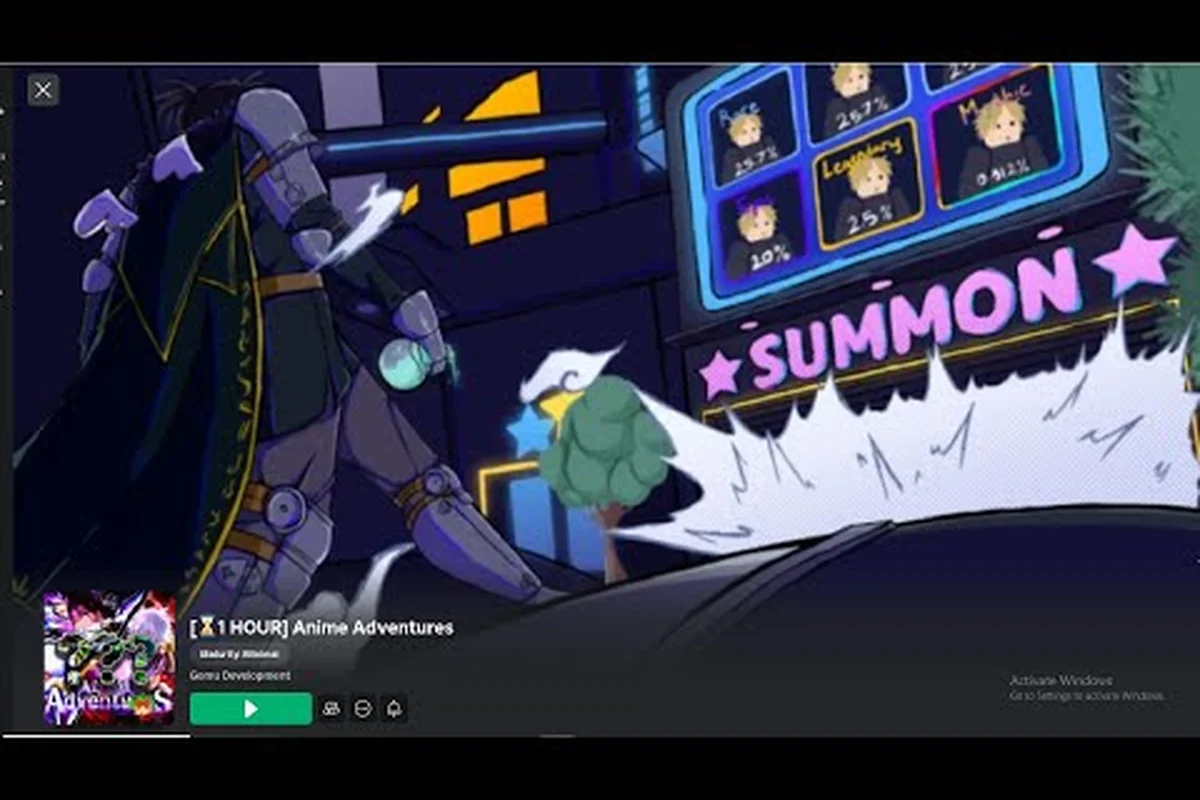
Anime Adventures Infinite Mode matters because repeated tower-defense waves turn positioning, unit coverage, and resource decisions into a repeatable progression plan. Use this guide to read the mode, build a resilient team, and decide when another run is worth the time.
Anime Adventures Infinite Mode Overview
Anime Adventures Infinite Mode is a community-described endless progression activity within a Roblox tower-defense game built around anime units, team composition, and wave survival. The official Anime Adventures game page confirms the broader structure: players collect characters, lead a team, level units to unlock abilities, and defend against incoming waves.
That foundation makes Anime Adventures Infinite Mode less about memorizing one answer and more about making repeated decisions under pressure. A strong setup survives early mistakes, concentrates damage where it matters, and preserves enough flexibility to respond when a later wave exposes a weakness.
Community guides identify Infinite Mode alongside Dungeons, Raids, story worlds, and limited-time event maps. However, Gomu Development has not published a complete stage list, wave count table, enemy statistics, unlock requirements, or reward amounts. The reliable approach is therefore principle-based: improve unit coverage, test positioning, observe the results, and adjust systematically.
| Infinite Mode consideration | Reliable approach | Unverified detail to avoid |
|---|---|---|
| Wave planning | Test by threat pattern | Exact enemy count per wave |
| Rewards | Track what you actually receive | Guaranteed item or currency amounts |
| Unit value | Compare coverage and synergy | Published damage rankings |
| Progression | Repeat a stable setup | Official level or wave caps |
| Unlock needs | Check the current game interface | Unsupported stage requirements |
Facts Listed on the Roblox Page
The official page identifies Anime Adventures as a strategy and tower-defense experience from Gomu Development. Its premise places heroes across multiple worlds after a catastrophic event, while the gameplay description centers on summoning characters, leveling units, unlocking abilities, and assembling a squad. Those details support a squad-oriented strategy, but they do not reveal the exact Infinite Mode layout or how many enemies appear in each wave.
The page also warns that other games using the Anime Adventures name are not affiliated with Gomu Development. This matters when researching an Anime Adventures Infinite Mode guide because look-alike Roblox experiences may publish unrelated stage lists, drop tables, or unit advice. Limit checks to the official place, official community channels, and clearly labeled community reports.
A practical Anime Adventures Infinite Mode cycle
Treat each Anime Adventures Infinite Mode run as a controlled test rather than a guarantee of rewards: compare the same dungeon, squad, and upgrade set across attempts, then record the wave reached, enemies cleared, and reward screen results. If a run ends earlier, review the Anime Adventures dungeon list and identify whether placement, unit coverage, or upgrade timing caused the failure; this creates measurable progress without inventing Anime Adventures Infinite rewards, fixed wave thresholds, or unconfirmed drop rates.
-
Enter with a stable squad. Use units whose attack patterns cover different lanes or enemy groups, even if their individual power is not proven.
-
Watch the opening wave. Note where enemies travel, where they cluster, and which unit types are attacked first.
-
Adjust placement before upgrading. A better position can solve a coverage problem that an expensive upgrade would only mask.
-
Test one change at a time. Moving one unit after a failed wave makes the lesson easier to understand.
-
Record the result. Track how far the team advanced, which placements held, and what the reward screen actually showed.
-
Repeat only when the run remains productive. Stop if each attempt ends at the same point without exposing a new improvement.
Treat the Anime Adventures Infinite Mode guide as a testing framework: log each dungeon entry, squad composition, placement changes, upgrade timing, wave reached, and reward-screen outcome. For example, if two attempts using the same Anime Adventures dungeon list both stall around the same enemy group, compare coverage before changing the squad; if a different lane or timing produces deeper progress, preserve that configuration. This turns observations into repeatable tests without asserting guaranteed Anime Adventures Infinite rewards, fixed Anime Adventures Infinite Mode wave thresholds, or unconfirmed Anime Adventures dungeon reward rates.
Preparing the Squad and Hero Positioning
Squad preparation for Infinite Mode should prioritize reliable coverage over speculative rankings. Community mentions confirm characters such as Rukia and Fusion Vegeto, but the reviewed sources do not establish their exact stats, placement tier, or role in the mode. Avoid presenting either name as a mandatory answer.
Instead, build from four observable questions: Does the unit attack a single target or a group? Can it reach the route where enemies gather? Does its ability create meaningful coverage? Can the team still function if that unit is removed for a moment? A squad that answers all four questions is usually more adaptable than one built around a single unverified recommendation.
| Preparation choice | Strong reason | Practical test |
|---|---|---|
| Balanced coverage | Handles mixed enemy groups | Run one full attempt without an early gap |
| Early investment | Tests whether stronger basics improve consistency | Compare the same wave before and after |
| Flexible placement | Reacts to lane pressure | Move one unit and rerun |
| Redundant coverage | Prevents one failure from ending the run | Remove one unit temporarily |
| Experimental unit | Learns a new role | Place it in a controlled position |
Choose coverage before tier claims
The Anime Adventures Infinite Mode guide becomes more practical when it separates role coverage from raw strength. Since no official damage values or tier placements are available, evaluate how each unit contributes to a complete defense. A unit that reaches the main cluster may be more useful than one with impressive appearance but limited reach, while a unit with group damage can shorten pressure if the wave groups enemies naturally.
For new players, the Anime Adventures first-hour guide can help establish the basic loop of summoning, leveling, and building a squad. Once those systems are familiar, return to Infinite Mode with a clear question for each unit rather than adding a larger team by default.
Position for the actual route
Positioning should follow the map’s enemy path. Watch how threats enter, where they bunch together, and whether the route allows a unit to cover more than one cluster. Do not assume a universal formation, because the reviewed sources do not publish official Infinite Mode map layouts or stage names. The correct formation for one run may be poor for the next if enemy movement changes.
A practical way to read a single Anime Adventures Infinite Mode defense is to log where enemies first appear, where they bunch up, and which path they take toward the defense area, then mark each cluster’s distance from your damage zone. If one cluster can be covered while another bypasses the range, shift a unit rather than upgrading its level. Because official Infinite Mode stage layouts and stage names are not published, use the current run’s spawn points and enemy path as your working map instead of copying a fixed formation from another difficulty.
-
Front coverage handles threats that reach the defense area first.
-
Group coverage becomes more valuable when enemies travel together.
-
Rear protection preserves a unit that cannot attack safely near the route.
-
Spread coverage reduces the effect of one crowded lane.
-
Mobile response matters when the group shifts and your original formation no longer reaches it.
Placement Before Progression is a useful rule: if a run fails because enemies bypassed your damage area, improve positioning before consuming more resources on leveling. If a unit remains in a useful position but its output feels inadequate, then progression is a reasonable next test.
Keep a controlled backup plan
A backup formation does not need a second complete roster. Identify which unit covers the most important weakness and prepare one alternative placement for it. If enemies bunch near the entry, move it forward; if they spread toward a different section, move it back or sideways when the map allows.
This practice prevents experimentation from becoming random. Record three things after every attempt: failed wave point, primary coverage gap, and next placement change. Community experience can suggest ideas, but only the current game run can confirm whether they work for the encounter at hand.
Infinite Rewards and Run Efficiency
Community coverage mentions Infinite Mode as a source of rewards, but the reviewed official sources do not publish reward amounts, exact drop tables, or a guaranteed-item schedule. Searches for Anime Adventures Infinite Rewards should therefore be evaluated carefully, especially when a guide promises a fixed number of gems, a particular item, or a known wave threshold without an official source.
The practical reward strategy is observation-based. Record the reward screen after each successful run, note the mode used, and compare repeated sessions. A reward that appears consistently may support a repeatable route, but one observation does not establish a guaranteed drop rate. Community reports can provide leads, yet the interface and current patch remain the final evidence.
| Reward-tracking entry | Record this | Why it matters |
|---|---|---|
| Run date | The current session | Separates older reports from current behavior |
| Stage or wave reached | The visible endpoint | Shows where the run ended |
| Items received | Exact names and quantities | Avoids estimating values |
| Run time | Start-to-finish duration | Measures farming efficiency |
| Team changes | Units and positions changed | Identifies what caused improvement |
| Attempts before success | Number of resets | Reveals the real resource cost |
Compare reward value by real cost
Two runs with identical screens may not have the same efficiency if one required many attempts and the other succeeded immediately. A useful comparison includes success rate, time invested, and whether the reward supports a larger progression goal. This matters for Anime Adventures Infinite Rewards planning because the best farm is not always the one that displays the largest number; it is the one that produces meaningful progress without excessive repetition.
For broader currency and material farming, the Anime Adventures farming guide provides a useful framework for comparing activities. Apply that framework to Infinite Mode by measuring actual rewards rather than assuming that an endless label automatically makes it the most efficient source.
Stop when marginal value drops
Set a stopping rule before grinding. A useful rule may be one successful reward-bearing run, a fixed number of attempts, or a time limit. Whichever threshold you choose, record what changed after the run. If the result is identical to the previous session, adjust the squad or move to another progression activity instead of repeating blindly.
Verified rewards outrank rumored rewards. A screen showing the items and amounts actually received is stronger evidence than an unsourced chart. Likewise, a community-reported reward route should be described as provisional until it is confirmed in the current game or official materials.
Use a three-run review
The three-run review provides a simple way to distinguish a promising setup from an unreliable one in Anime Adventures Infinite Mode: use each run to test a specific team, placement, and dungeon condition, then compare the same objective rather than relying on a single clear. For example, if a coverage team improves in one run, test whether that gain persists when the enemy pattern or available dungeon rewards change. This helps separate a genuine team advantage from a lucky clear and makes later comparisons with Infinite Rewards, dungeon rewards, and raid formations more meaningful.
-
Run one: Establish a baseline with the current team and placement.
-
Run two: Change one meaningful variable, such as coverage or lane position.
-
Run three: Repeat the strongest configuration to test consistency.
If the third run matches the second and both improve on the first, keep the arrangement. If results vary widely, check whether the enemy pattern changed, whether a critical ability was unavailable, or whether your position was disrupted. Avoid treating a single lucky clear as proof that a setup is permanently optimal.
How Dungeon and Raid Rewards Differ
Anime Adventures Dungeon and Raid modes are often discussed alongside Infinite Mode, but the reviewed official material does not provide a complete Anime Adventures Dungeon list, Anime Adventures Raid list, stage count, wave structure, or reward table. Community guides identify Dungeons and Raids as separate mode families, which makes comparison useful, yet exact rankings would be speculation.
The most reliable comparison focuses on the purpose of each mode within a progression plan. Infinite Mode emphasizes repeated defense decisions. Dungeons provide another wave-based objective for testing team strength, while Raids represent a distinct activity that may require different preparation. Do not assume that a squad that performs well in one automatically dominates the others.
| Mode | Best-supported focus | Evidence limit |
|---|---|---|
| Infinite Mode | Repeated defense and reward collection | No official stage or reward table |
| Dungeon | Alternate wave-based progression | Community identification only |
| Raid | Separate team challenge | No official wave or reward data |
| Story worlds | Story progression across multiple worlds | Full stage list unpublished |
| Limited event | Time-sensitive map participation | Event details can change |
Choosing between modes
Choose Infinite Mode when you want to refine repeated defense performance and collect observed rewards. Shift to a Dungeon when you want another combat test or need an alternative source of progression. Try a Raid when you are ready to evaluate the same squad under a different challenge structure. None of these choices requires unsupported claims about which mode gives a fixed number of rewards or clears fastest.
A complete Anime Adventures Dungeon guide should still account for entrance requirements, enemy patterns, and the rewards actually received. Since those specifics are not published in the reviewed sources, inspect the current interface before committing resources. Community reports may be useful after that inspection, especially for understanding what experienced players found difficult, but they should remain clearly labeled.
For mode-specific preparation, the Anime Adventures raid guide can help organize the broader comparison. Use it to distinguish what is known about Raid preparation from assumptions about Infinite Mode, rather than transferring an unverified reward claim from one activity to another.
Think in progression goals
Set a purpose before entering a mode. If the goal is reward farming, record the exact reward and the effort required. If the goal is unit testing, bring one experimental change and keep the rest of the squad stable. If the goal is basic progression, choose the activity with the clearest current unlock path. This prevents repeated clearing without knowing whether it improves the account.
Anime Adventures Dungeon Rewards and other reward claims should be measured with the same standard. A reward received in a Dungeon does not prove that Dungeons are the best Infinite Mode source, and a reward shown after Infinite Mode does not guarantee a repeatable rate unless the evidence supports it. Keep each mode’s result in its own log.
Improving Anime Adventures Infinite Mode Performance
Performance improvement starts by identifying the failure mode. A broken defense may come from weak coverage, poor placement, insufficient development, or a unit combination that struggles against the current pattern. Treating every loss as a general team problem wastes resources because each cause requires a different response.
| Failure pattern | Likely issue | Next action |
|---|---|---|
| Enemies pass through undefended areas | Coverage or placement | Shift a unit or change the route response |
| A group reaches the defense together | Group-control gap | Test a unit with wider coverage |
| One unit appears ineffective | Role mismatch | Move it or replace it for one trial |
| Early waves are stable, later waves fail | Scalability gap | Improve development or add coverage |
| Runs end at the same point | Unresolved configuration | Change one variable and retest |
| Rewards do not match expectations | Unverified assumptions | Record actual results instead of forcing a route |
Diagnose before upgrading
Leveling is valuable because the official game description says units can be leveled to unlock abilities. Still, upgrading without a diagnosis can hide the real issue. If a unit is outside the effective range, a higher level may not change the encounter; if a team lacks group coverage, a single damage increase may not prevent a clustered breach.
In an Anime Adventures Infinite Mode run, treat a level increase as a hypothesis rather than an automatic fix. If a unit’s attack range stops short of the enemy’s approach lane, raising damage cannot help because the unit never enters its effective targeting window; if several enemies reach the same crowded area, a single-unit damage upgrade may leave the breach unresolved. Compare the unit’s range, ability timing, and group coverage against the wave that caused the first failure, then test one targeted adjustment before committing more resources.
-
Identify the earliest point where the defense becomes unstable.
-
Determine whether the problem is reach, clustering, timing, or unit performance.
-
Make the cheapest relevant change.
-
Test against the same baseline.
-
Keep the change only if it produces repeatable improvement.
This method is especially valuable for an Anime Adventures Infinite Mode strategy because it produces observable decisions rather than a generic upgrade list. Tracking the exact wave where the first breach occurs also shows whether a weak unit is failing because of reach, attack timing, or insufficient unit performance. For example, if a ranged unit cannot cover the enemy’s approach lane, repositioning the formation or changing the targeted unit may solve the problem without spending more resources. It also helps players understand which parts of their squad are actually contributing, making every Infinite Rewards purchase tied to a reproducible defensive improvement.
Rotate experiments deliberately
A strong run should not end all experimentation. Preserve the configuration, then test a second unit or alternative placement. The goal is to identify multiple workable formations, since future events or enemy patterns may reward flexibility. A team with one perfect answer can fail when the map or encounter changes; a team with a dependable backup has a better chance of maintaining progress.
Community reports can contribute ideas, but the term “community-tested” does not mean permanent. Enemies, rewards, and modes can change with updates, and the current reviewed content cycle is Update 20, with community coverage preparing for Update 21. Verify every claim in the live game before treating it as current.
Track performance without inventing a score
Create a simple record after each Anime Adventures Infinite Mode attempt instead of inventing a precise damage formula that no official source supports. Note the wave reached, leak point, effective unit, weak unit, and next test for every run. For example, if enemies bypass your Anime Adventures dungeon defense on Wave 12 twice, test whether repositioning the effective unit or replacing a weak unit changes the outcome. Because Infinite Mode rewards and difficulty progression lack a reliable public damage table, these repeatable observations provide more actionable evidence than an estimated DPS score.
-
Wave reached: the visible endpoint.
-
Leak point: the first location where enemies slipped through.
-
Effective unit: the unit that produced the clearest coverage.
-
Weak unit: the unit that contributed least or was poorly placed.
-
Next test: the single change planned for the next run.
After several sessions, patterns become clearer. If the same leak point appears in three Anime Adventures Infinite Mode runs, treat it as a structural placement problem rather than bad luck—for example, a repeated opening at the side corridor may show that the effective unit’s coverage is being bypassed. If results swing randomly, compare the wave reached, unit availability, and squad composition between runs; losing access to a key Anime Adventures unit can expose a weak unit’s limitations that were hidden in the previous formation.
Community Reports, Verification, and Reliable Sources
The Anime Adventures Infinite Mode guide should separate official facts from community interpretation. The official game page confirms the tower-defense foundation, unit collection, squad building, leveling, and multi-world premise. Community coverage identifies Infinite Mode, Dungeons, Raids, Evolution, Starfruit, Relic, Limit Break, Gem, and other named systems. Those community terms are useful for navigation, but the reviewed sources do not provide official probability tables or a complete numerical balance sheet.
The safest way to verify a claim is to ask which part of the current game confirms it. A visible stage name, reward panel, unit ability description, or unlock requirement is direct evidence. A statement copied from an old guide may be outdated. A tier ranking without methodology is opinion. A wave total without a stage label may refer to a different map or version.
| Claim type | Confidence marker | Best verification |
|---|---|---|
| Official game premise | Official page | Current game page |
| Mode names | Community guides | In-game mode list |
| Stage or wave total | Unverified unless currently visible | Read the live map |
| Reward amount | Unverified without a table | Inspect the reward screen |
| Unit role | Unverified without stats | Observe attacks and ability description |
| Tier placement | Community opinion | Treat as a preference, not fact |
| Drop rate | No reviewed official table | Do not claim a guaranteed rate |
Read community advice critically
Community experience is valuable for discovering strategies, but it must be filtered through the evidence rules above. The official Anime Adventures Discord is linked from the game page and functions as a major community hub for announcements and discussion. Information shared there should still be treated as a community report unless it is also confirmed on the official game page or the developer’s official video channel.
This is particularly important for summon rates, drop rates, and tier placement. No verified summon rates, reward amounts, damage values, level caps, or dated Update 21 release were available in the reviewed sources. A guide that fills those gaps with unsupported numbers may look more specific, but it gives the reader less reliable information.
Keep the research scope narrow
Only two unit names had verifiable community mentions in the reviewed material: Rukia and Fusion Vegeto. Even those names do not come with confirmed Infinite Mode roles, damage figures, or rankings. Do not import teams, stages, or player data from another Roblox game with a similar title, and do not treat a result from the wrong place ID as relevant to the official Anime Adventures experience.
For economy-focused testing, the Anime Adventures Infinite Mode Gems guide can help you evaluate whether repeated runs are improving gem progress. Keep that evaluation tied to observed rewards and time invested, because no official Infinite Mode gem schedule is published in the reviewed material.
A final source checklist
Before accepting a strategy, confirm that it identifies the correct official experience, uses terminology that appears in the current game, and separates observation from prediction. It should also explain what changed the result rather than merely claim that a particular unit, stage, or item is best. If the advice depends on an exact reward, wave count, or unlock condition, look for a current screenshot or direct in-game confirmation.
Frequently Asked Questions
What is the best team for Anime Adventures Infinite Mode?
No verified best team or tier placement is available for this mode. Build around verified coverage instead: multiple attack patterns, a clear answer to grouped enemies, and at least one dependable backup placement. Community mentions confirm Rukia and Fusion Vegeto as existing characters, but their exact Infinite Mode roles are not published, so test them rather than assuming either is mandatory.
How should I improve my Anime Adventures Infinite Mode results?
Improve one problem at a time. Record the first point where enemies become difficult, identify whether the issue is reach, grouping, timing, or unit performance, and then make the cheapest relevant change. Test that adjustment against the same baseline. A strong Anime Adventures Infinite Mode guide should help you learn which decisions work, not prescribe unsupported unit rankings or exact wave thresholds.
Are Anime Adventures Infinite Rewards guaranteed on every run?
The reviewed official sources do not publish a fixed reward table, drop rates, or guaranteed amounts for Infinite Mode. Record what appears after each successful run and compare several sessions. Community-reported reward routes may help form a hypothesis, but the current reward screen is the strongest evidence, and repeated identical observations are needed before calling a route consistent.
Where can I find an Anime Adventures Dungeon list or Anime Adventures Raid list?
The reviewed official sources do not provide a complete Dungeon or Raid stage list. Community guides identify both as separate mode families, but they do not verify every stage, wave count, or unlock condition. Check the live mode menus and maps in the official Roblox experience, and treat older community lists as provisional until their entries match the current interface and update cycle.
Should I use the same squad for Dungeons, Raids, and Infinite Mode?
You can start with the same core squad, but you should not assume identical results because each mode family may present different enemy patterns and objectives. Use Infinite Mode to test repeated defense and reward efficiency, a Dungeon as a separate progression challenge, and a Raid as another evaluation of team preparation. Keep the same measured variables—wave reached, leak point, rewards, and time spent—across each comparison.